Republican Socialism Is Bad For America · Episode 03 · Tier A — Capital Socialism
The People's Portfolio
The federal government is now an equity holder in more than a dozen private companies — a portfolio built on defense authorities and industrial-policy statutes — while the administration says tariff revenue will pay for everything and DOGE says it is saving taxpayers $110 billion. Neither claim holds up to its own government's numbers.
Tier A · Capital Socialism Every number below traces to a primary receipt. Click through.
Watch
Rough cut preview · real assets, sequenced by production order · not the final render.
Long-form · target runtime ~15 minutes (narration recorded, 3.2 min measured cut in progress). Vertical and square cuts below play from the same file once rendered.
Shorts & cuts
The Visual Basis (23 real production stills)
Every frame below is an actual rendered beat from this episode's build. These are the raw material the cut is built from, not stock or AI-generated art.

The Story
Somewhere in the last eighteen months, without a floor vote and mostly without anyone watching, the United States government became an investor. Not in bonds. Not in Treasury bills. In private companies — the kind of stake a hedge fund takes, taken instead by the Department of Defense.
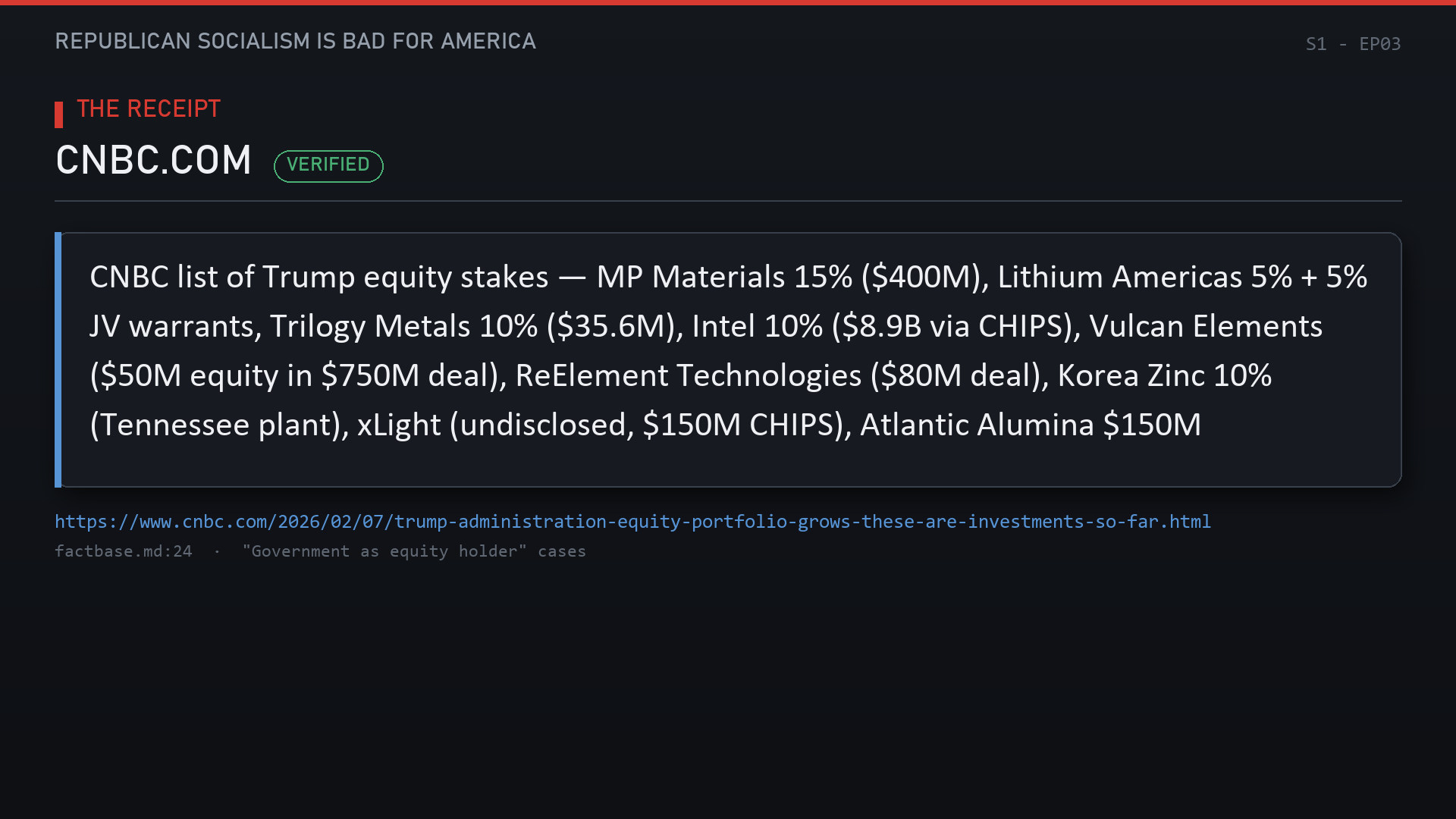
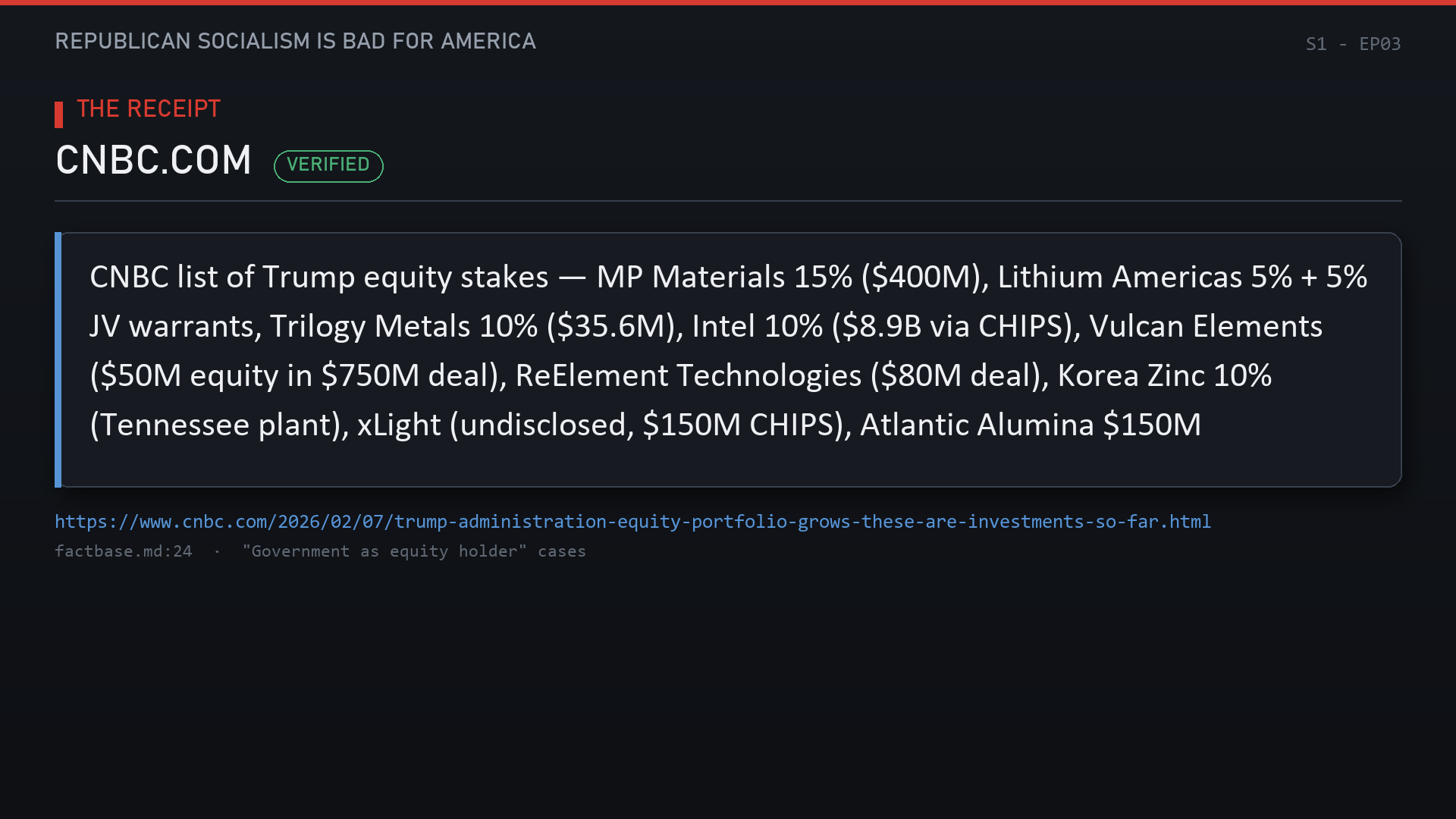
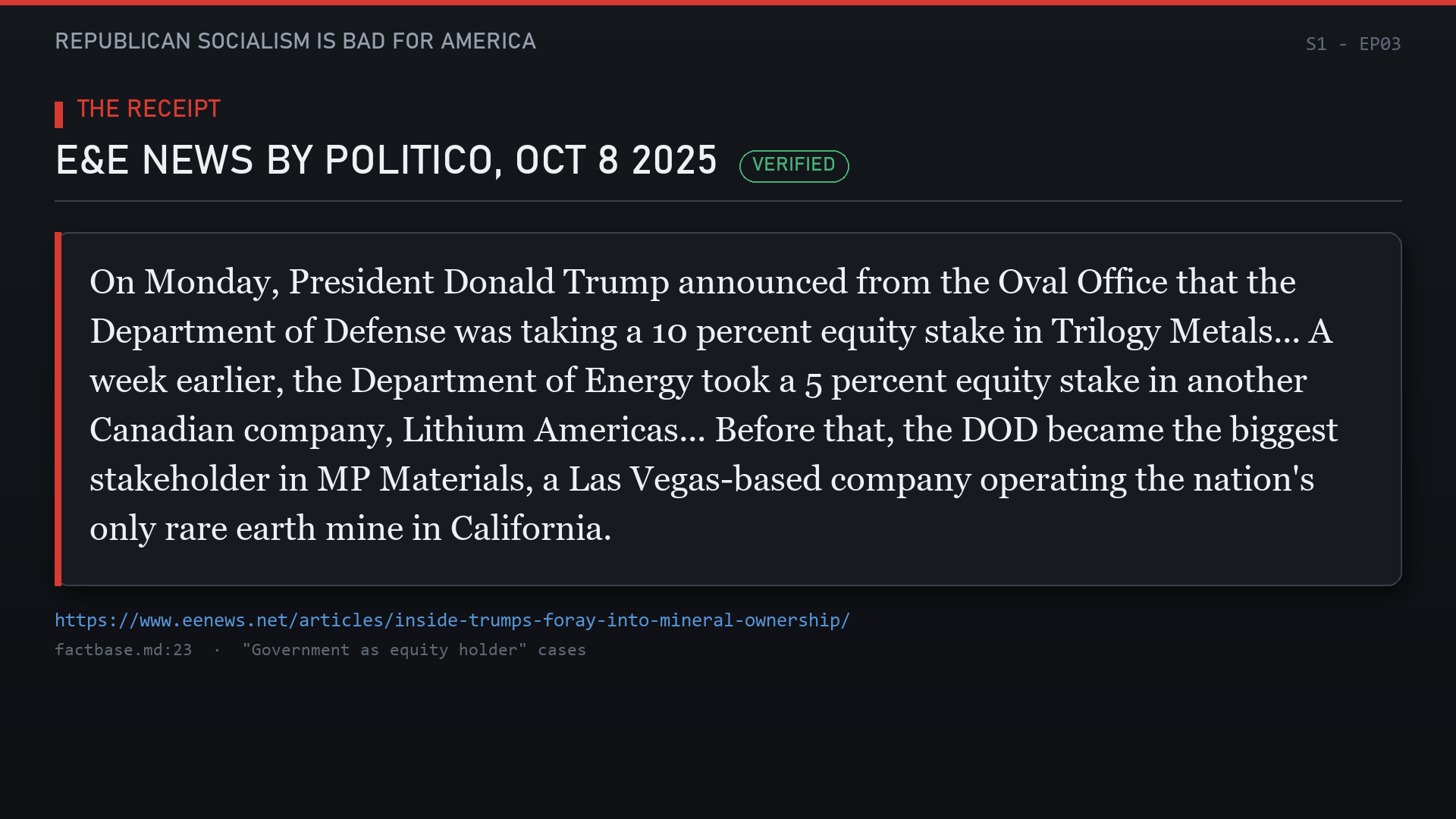
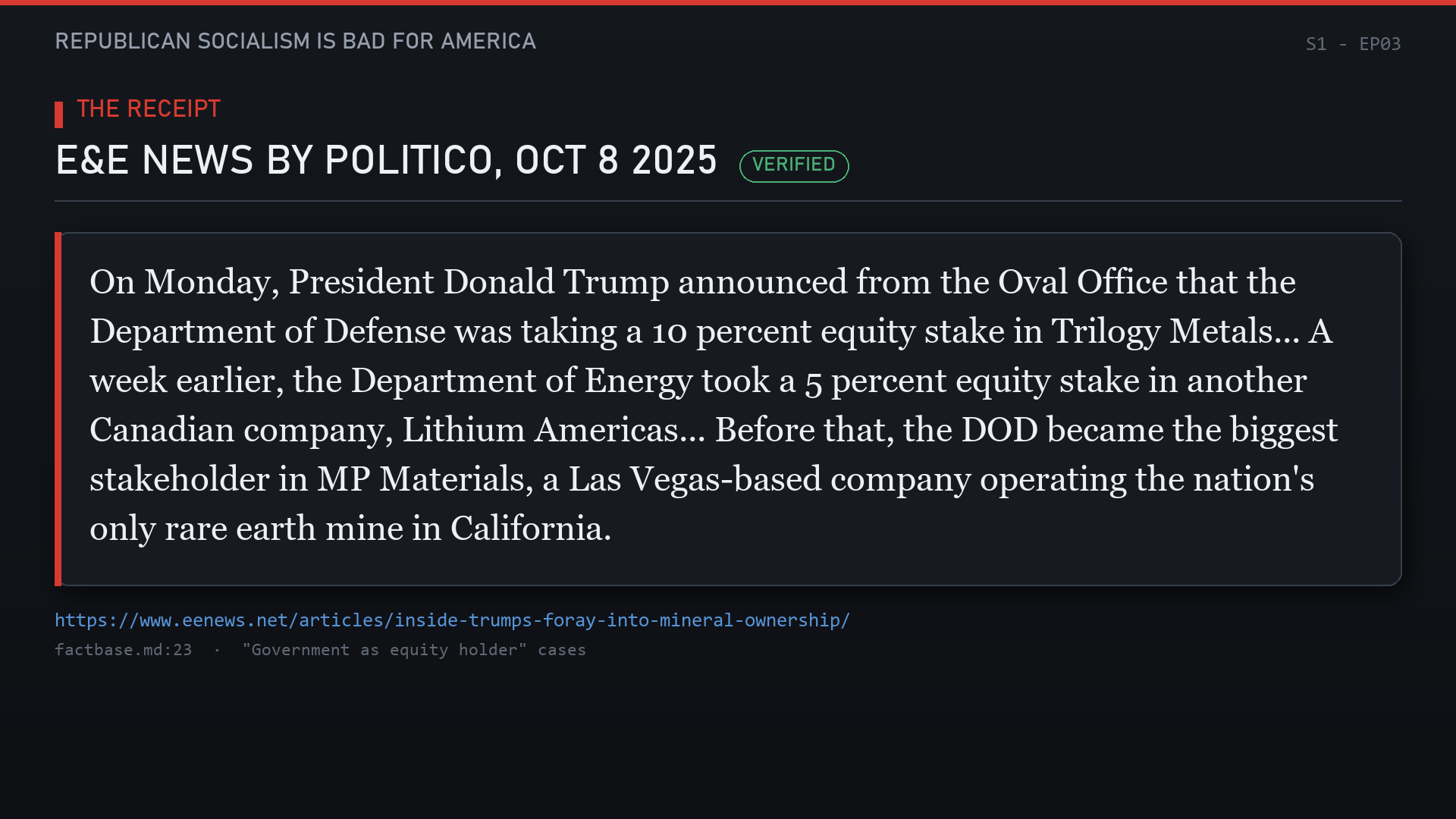
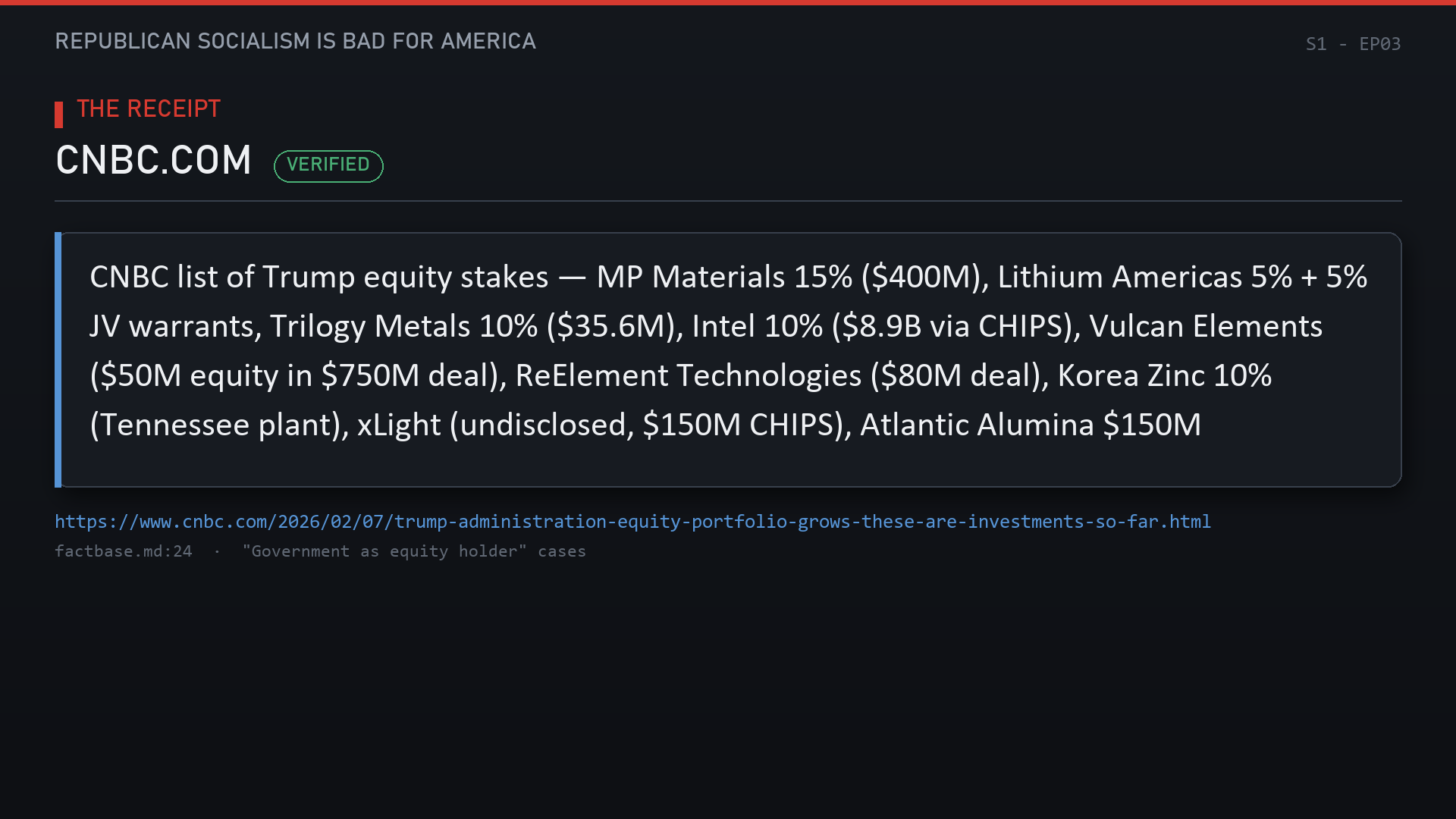
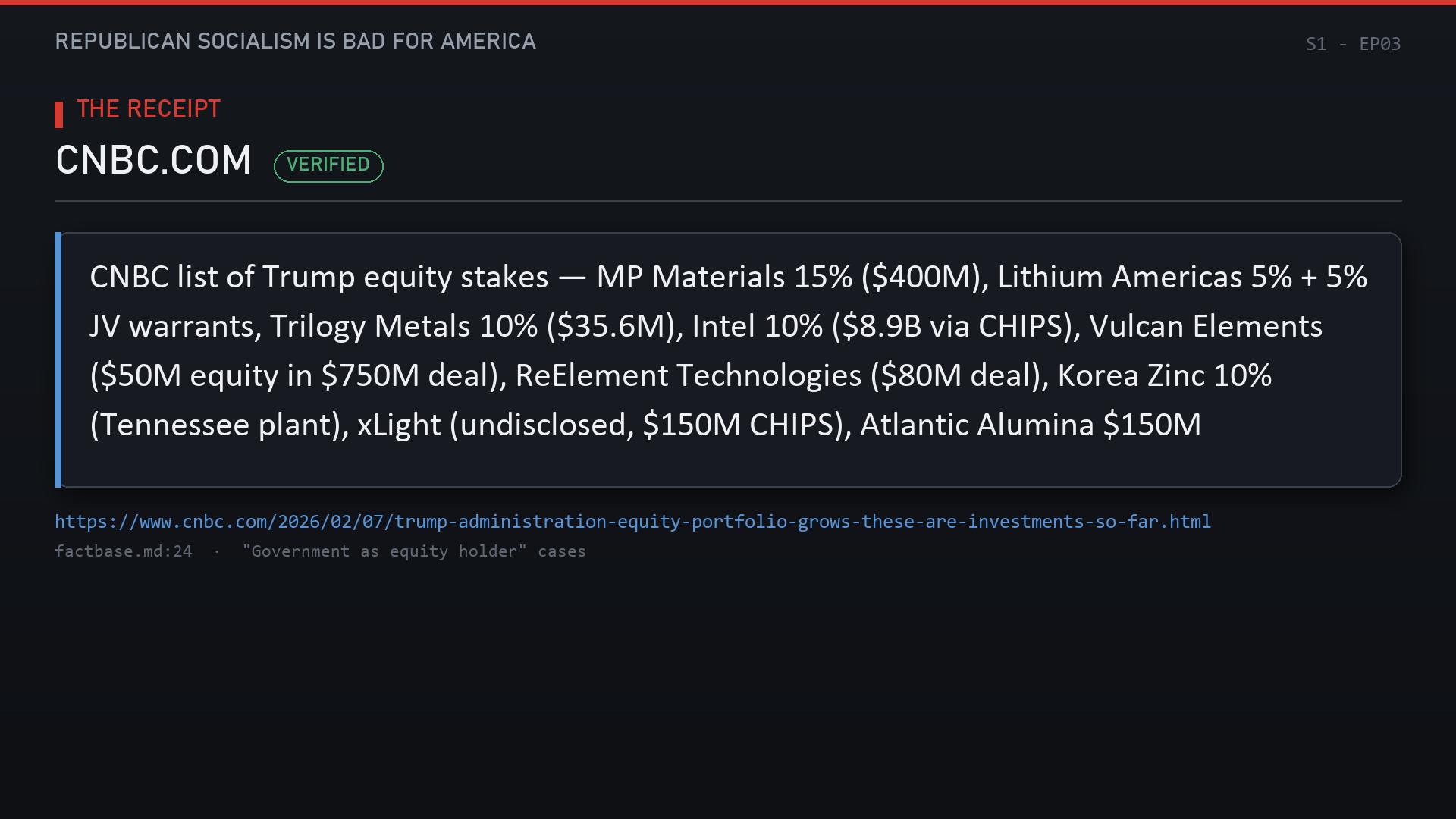
Start with the shape of the portfolio. The Pentagon took a 10% stake in Trilogy Metals for $35.6 million, and a piece of Lithium Americas alongside 5% of its joint-venture warrants. It became the largest shareholder in MP Materials, a position that can grow to 15% on $400 million committed. CNBC's running tally adds Korea Zinc, Vulcan Elements, ReElement Technologies, xLight, and Atlantic Alumina. That is not a subsidy line. That is a spreadsheet with tickers on it.
The biggest position is Intel: 433.3 million shares at $20.47 each, a 10% stake, bought by converting $5.7 billion in CHIPS Act grants and $3.2 billion in federal secure-chip awards into equity instead of handing the money over as a straight grant. As the episode's own reporting puts it: "That is not a subsidy. That is a cap table entry."
Add it up and the Council on Foreign Relations counts $27.7 billion across 39 deals of direct government ownership announced since January 2025 — Commerce leads with 24, the Pentagon has 9, Energy has 2, the Development Finance Corporation has 6. A Congressional Research Service product from August 2026 catalogues the whole toolkit: equity, loans, partnerships, revenue sharing — even a golden share Washington took in U.S. Steel as a condition of letting Nippon Steel buy it.
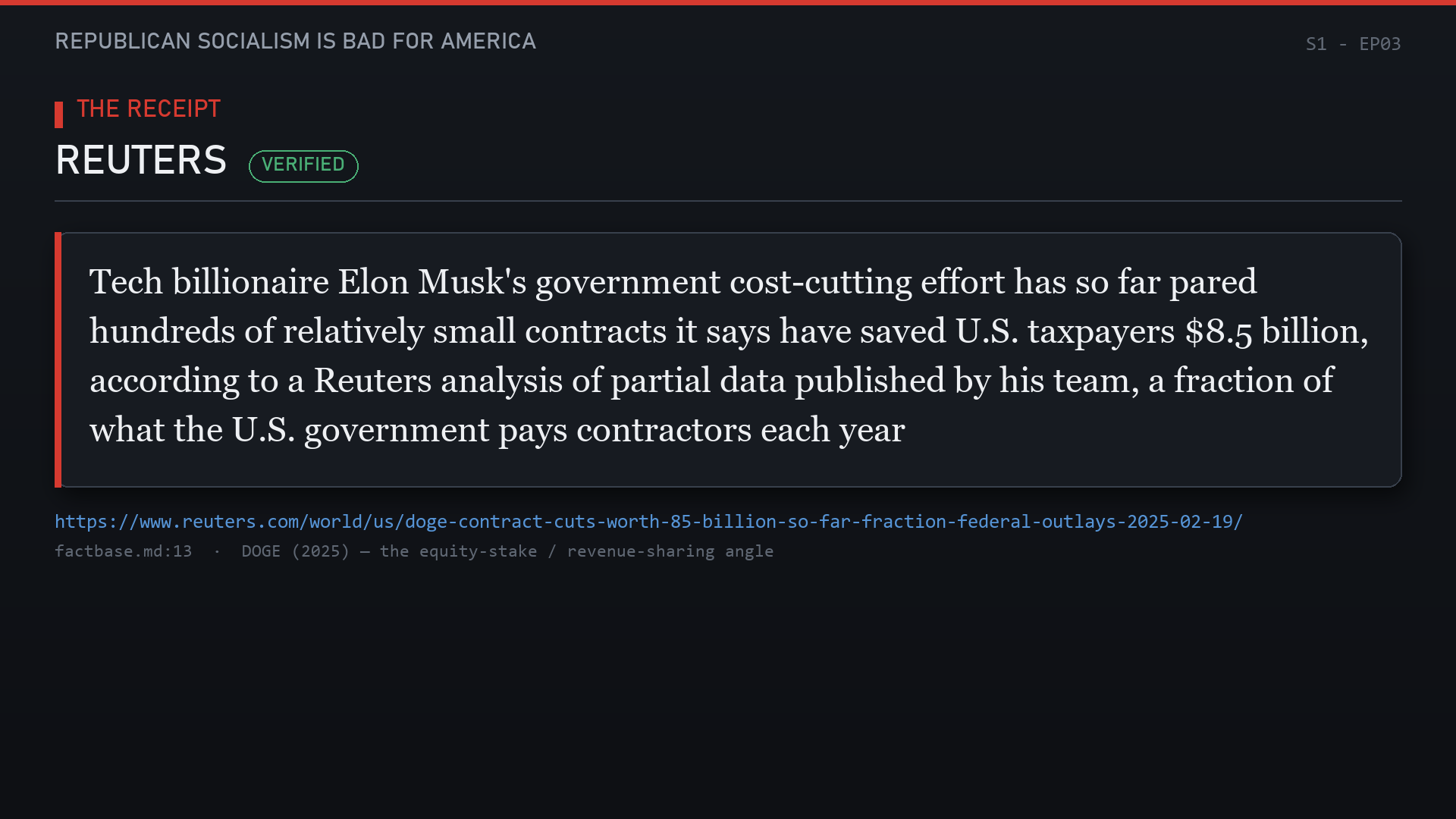
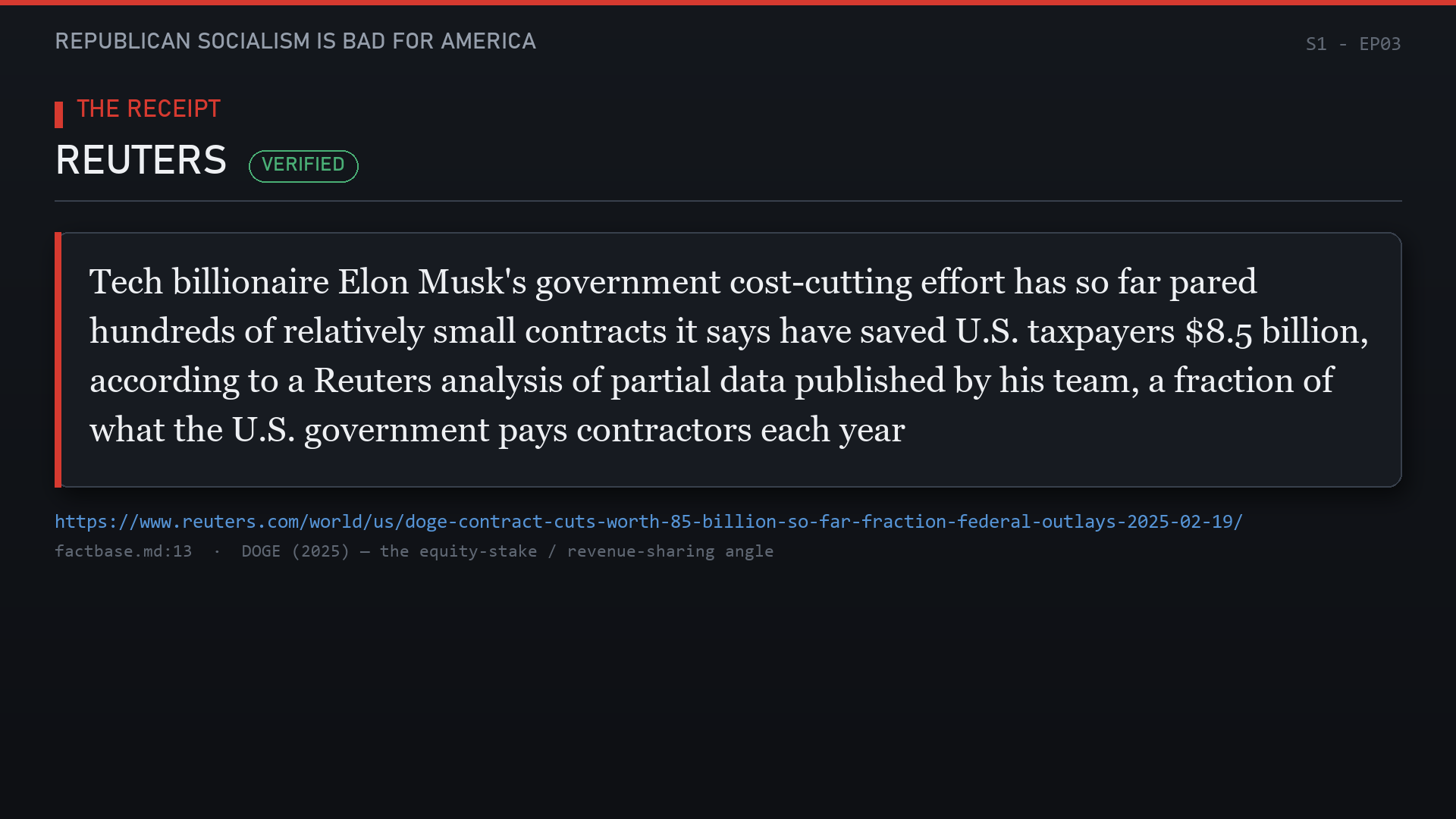
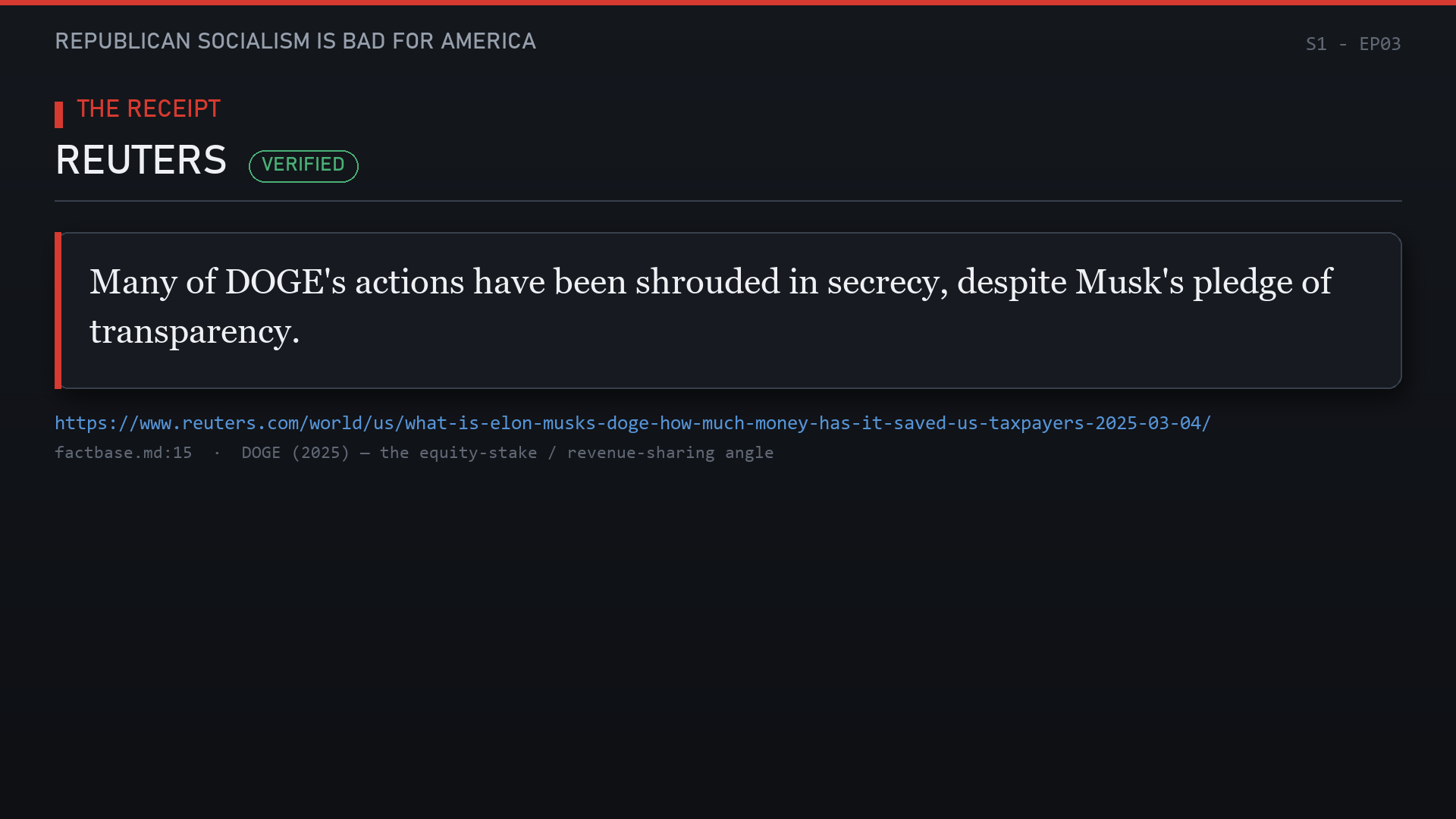
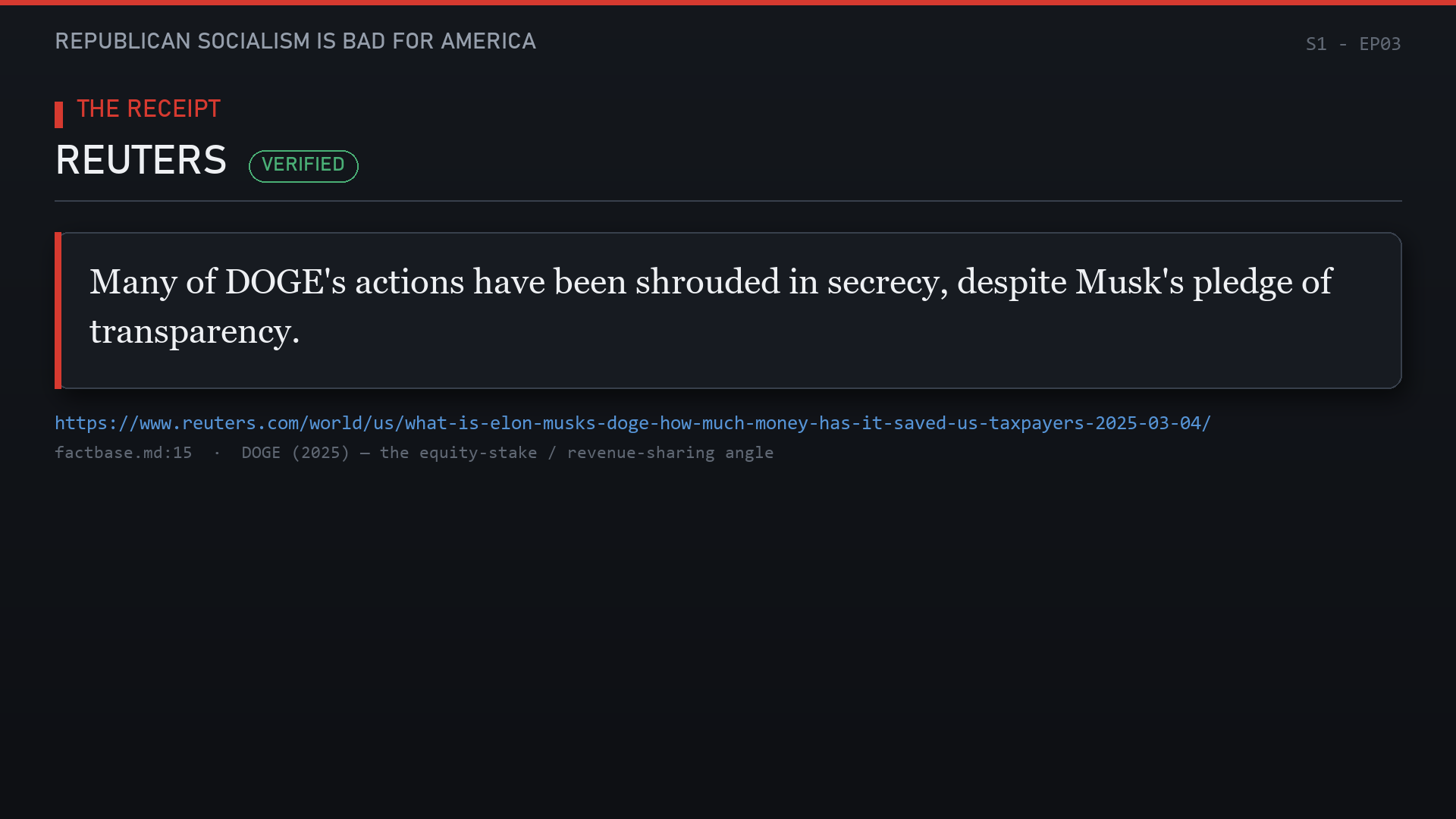
The official story is that all of this is being paid for — that DOGE has already found the money. DOGE's own "Wall of Receipts" claims $110 billion in savings as of July 2026. But the Government Accountability Office looked at the wall and found some of the savings estimates "incorrect or lack supporting evidence" — including 2,503 listed contracts, worth $27.4 billion, on which no termination action was ever taken. Reuters's own count of the published data put real contract cuts at $8.5 billion — an eighth of the number on the wall.
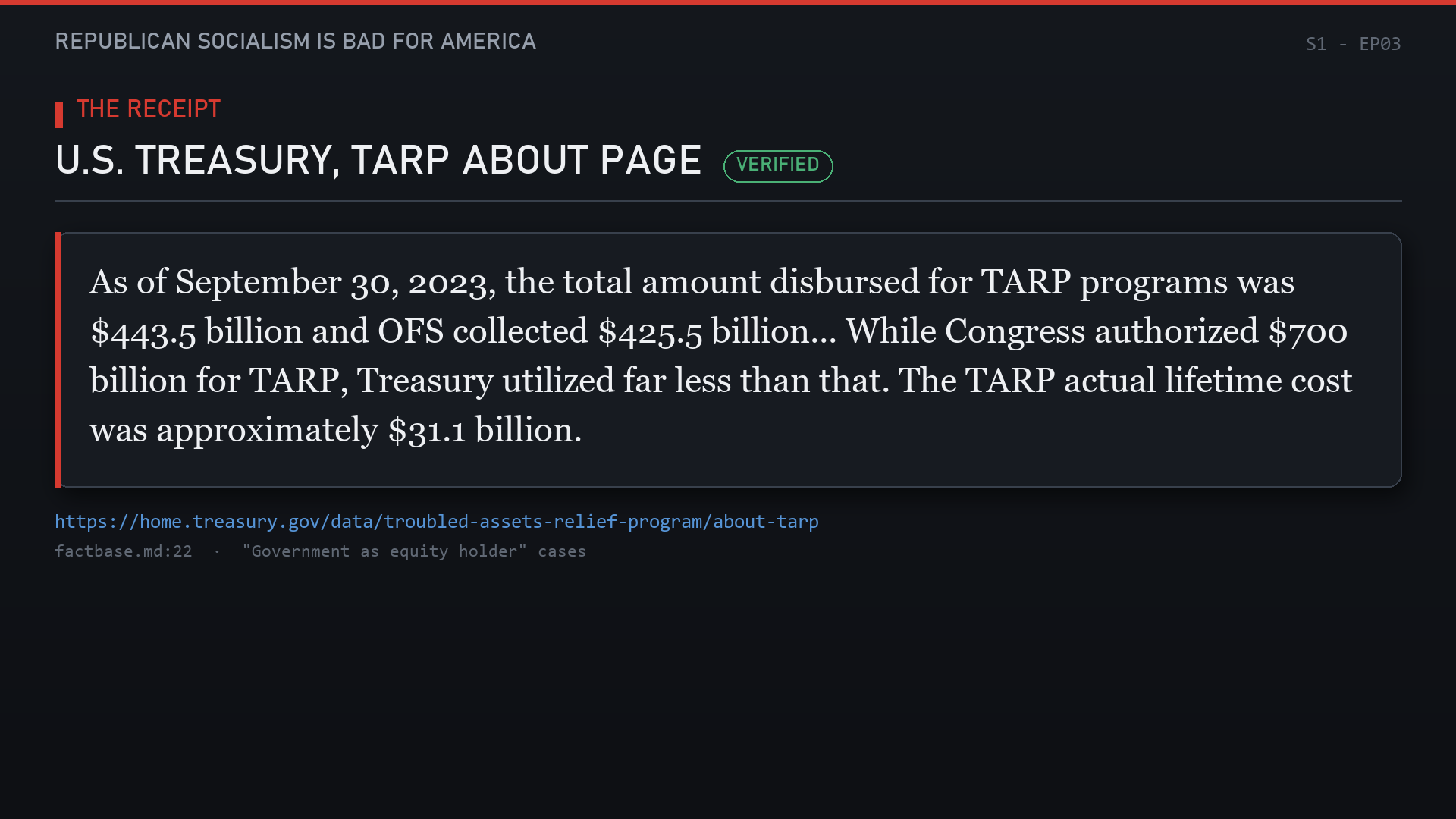
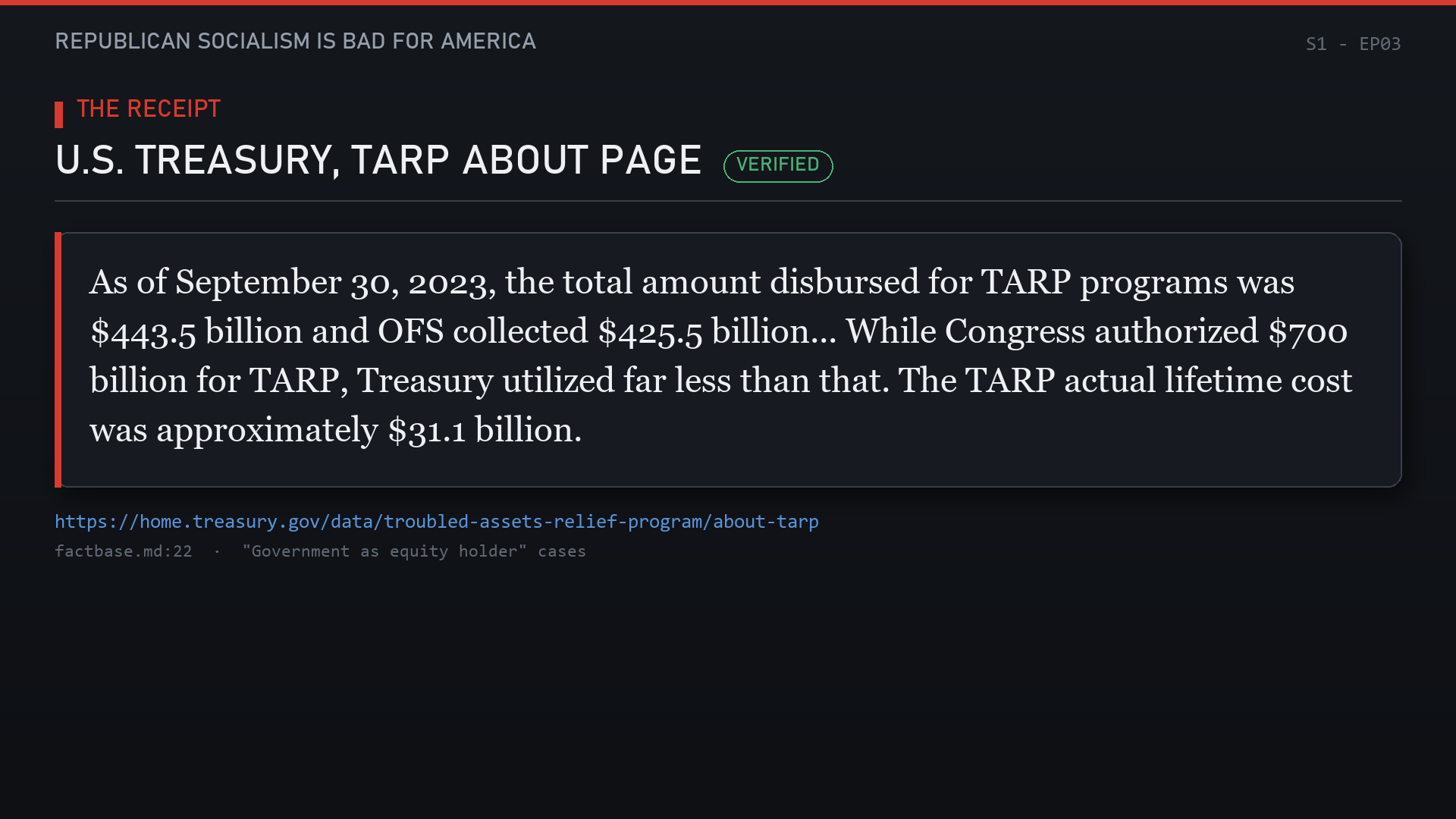
There is precedent for Washington holding equity like this — it just isn't much comfort. TARP authorized $700 billion, disbursed $443.5 billion, and collected $425.5 billion back, for a lifetime cost of roughly $31.1 billion — and Congress voted on every dollar of it. Today's stakes were built without that vote: defense authorities, loan renegotiations, and merger conditions standing in for a bill with a roll call.
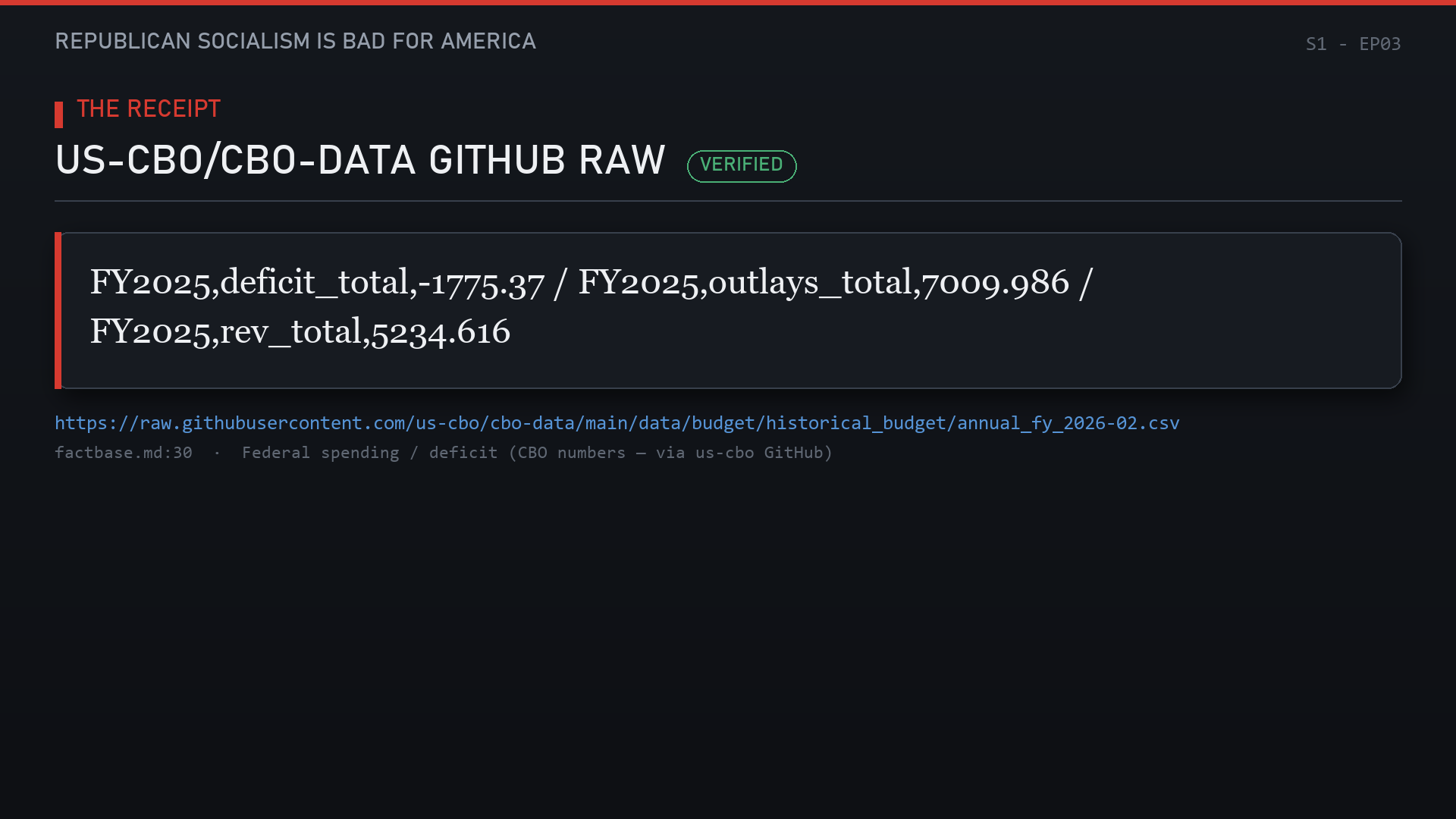
Meanwhile the bill for everything else keeps growing. The Congressional Budget Office put FY2025 outlays at $7.010 trillion against $5.235 trillion in revenue — a $1.775 trillion deficit. FY2026 was projected in February at $7.449 trillion in outlays and a $1.853 trillion deficit, 5.8% of GDP, with debt held by the public climbing to 100.6% of GDP. By July, CBO had revised that estimate upward again, to $2.1 trillion — $200 billion worse than its own February forecast.
And here is the part that changes the whole plan. The administration's answer to "how do we pay for it" was tariffs — a promised $2,000-per-person dividend, plus paying down "$37 Trillion" in debt, on numbers that independent estimators (Tax Foundation: $1.5T over ten years; Penn Wharton: $2.1T) never matched in the first place. Then on February 20, 2026, the Supreme Court ruled the administration had no authority to impose those tariffs under IEEPA. CBO now estimates 2026 tariff and customs collections will land about $250 billion — 60% — below earlier projections, and roughly $100 billion has already gone back out the door in refunds. The financing plan for the portfolio just got overruled by the branch of government that was supposed to referee it.
Zoom out and the picture is a government that bought a stake in more than a dozen companies using authorities that never needed a floor vote, funded by a savings claim its own watchdog can't verify and a tariff windfall its own Supreme Court just cut in half. The equity itself might turn a profit someday, the way TARP eventually did. That was never really the question. The question is who signed off, and who is holding the paper if it doesn't.
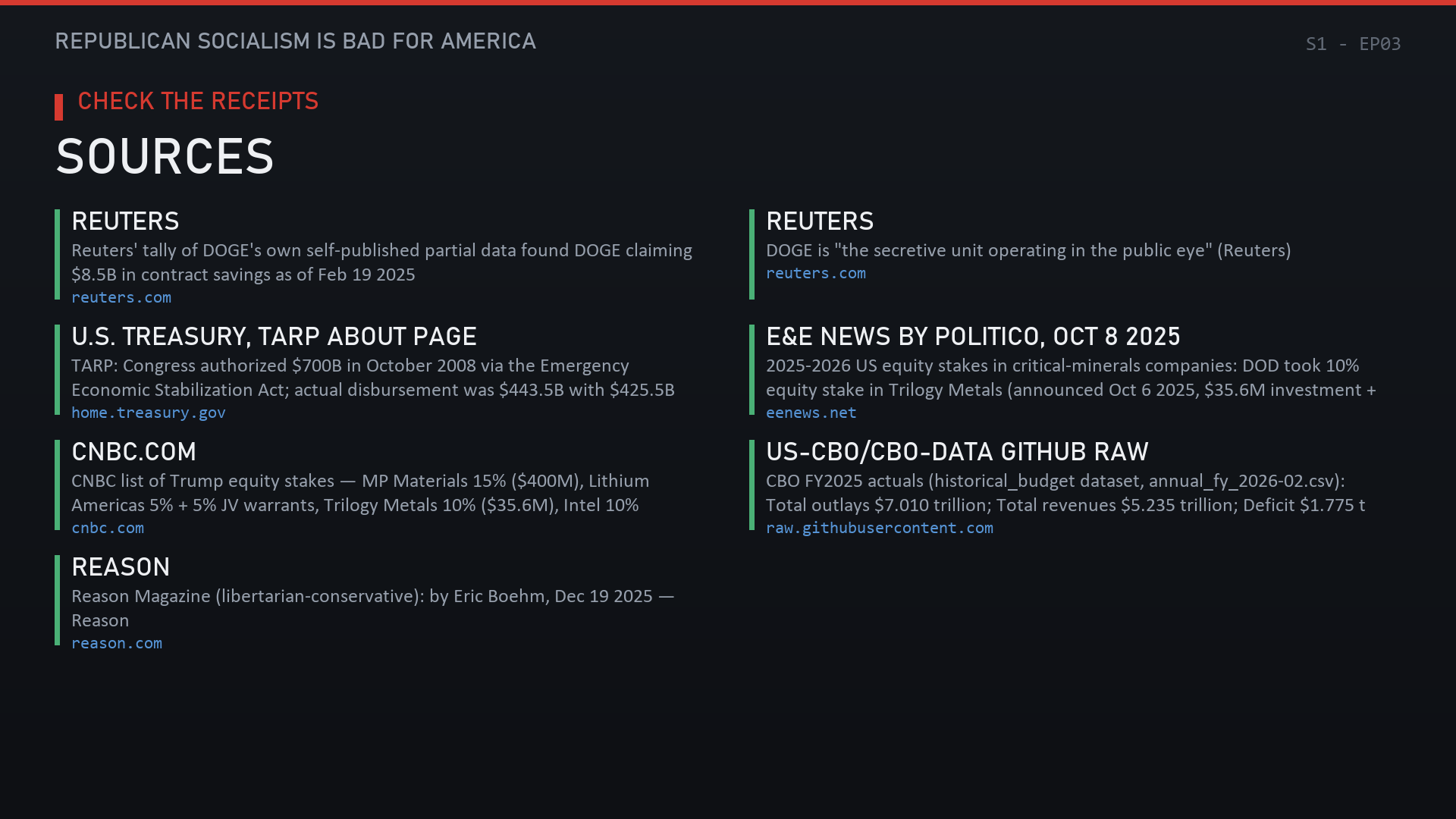
Receipts: E&E News by POLITICO · CNBC, Feb 7 2026 · U.S. GAO, GAO-26-108615 · Reuters, Feb 19 2025 · U.S. Treasury, TARP About page · CBO, Monthly Budget Review: July 2026 · PBS NewsHour / PolitiFact
The steelman
The strongest counter, aired straight: these are not permanent nationalizations. An administration official told CNBC the Lithium Americas equity is "a very small stake of equity to create essentially a cash buffer and eliminate some risk on behalf of taxpayers." The government is "acting as a strategic investor" to help firms hit a commercial return and a national purpose. Commerce Secretary Lutnick said the Intel stake is non-voting with no governance rights. And TARP shows Washington can take equity in a crisis and largely get the money back.
The rebuttal
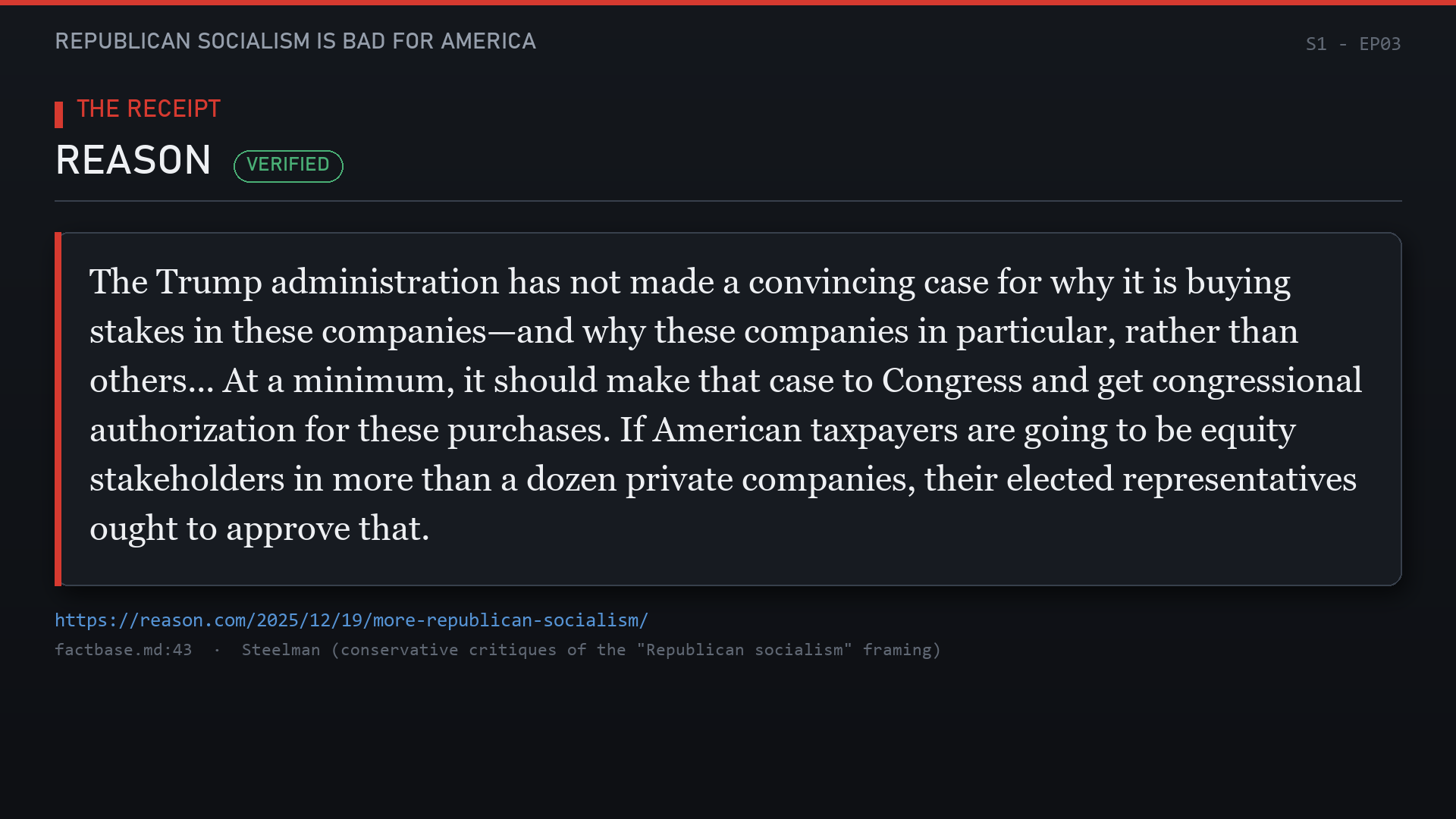
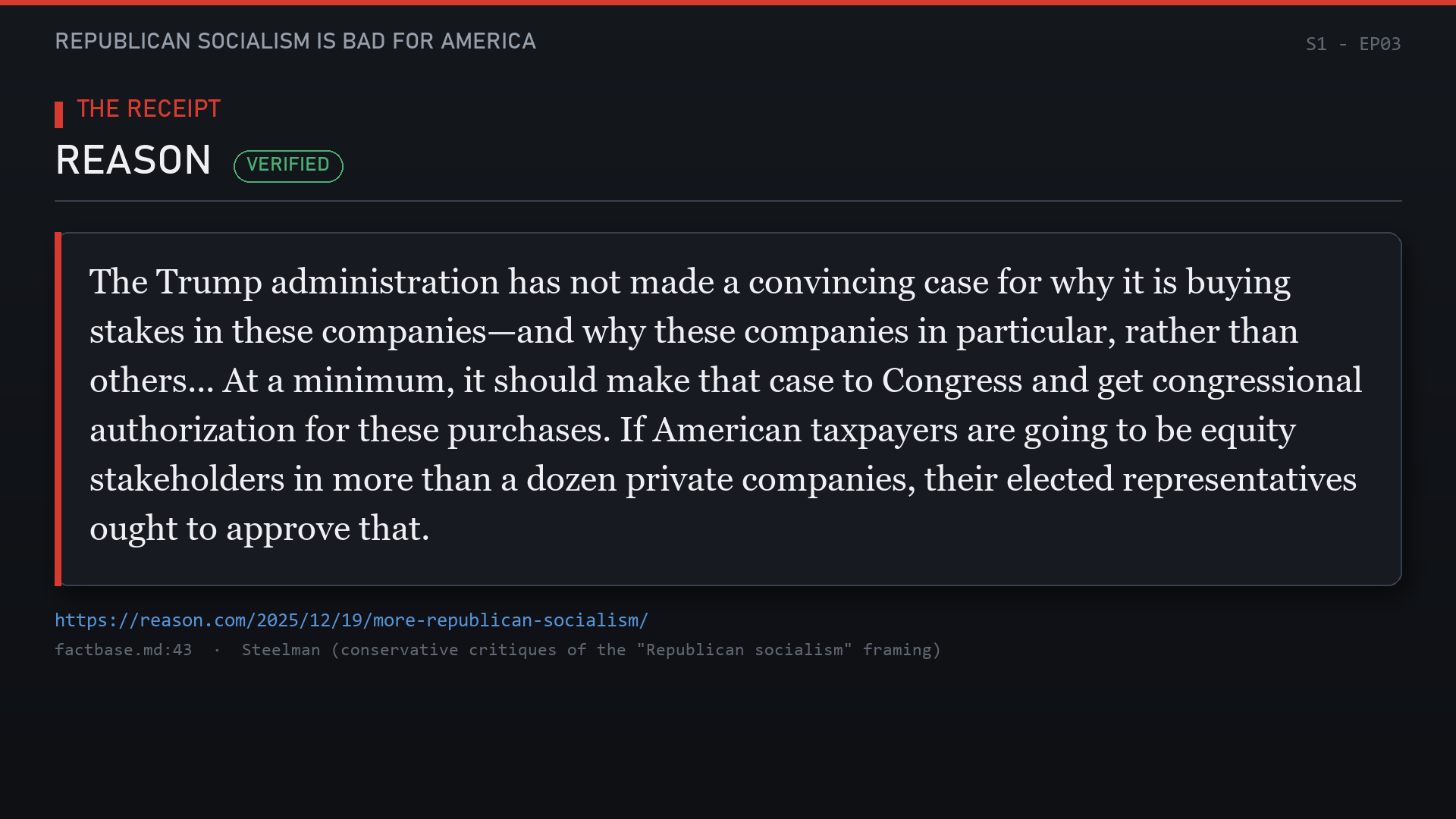
Answered honestly, that case has three problems. Authorization: Reason magazine says the administration "has not made a convincing case for why it is buying stakes in these companies—and why these companies in particular," and that Congress should approve any taxpayer equity portfolio. Creep: National Review, quoted by economist Dan Mitchell, warns that once government holds a financial interest in a firm, "the interventionism never ends there" — officials privilege their investments over other firms, the same state-capitalism model that has "faltered in China." Scale: a Cato Institute count puts the federal corporate portfolio at roughly 30 firms; federal ownership of private companies "has become routine," even as the same party calls the opposition socialist. The Wall Street Journal's Greg Ip calls it "a two-way street" — aligned firms get better treatment on tariffs, regulation, and mergers. And the New York Times's Bret Stephens, quoted by Mitchell, is blunt: "If a Democratic president did this… Republicans would call it a political shakedown, an assault on capitalism, a loser for taxpayers. They'd be right."
A government that buys private companies in secret is not cutting government. It is hiding it behind a brokerage statement.
Documents Used to Produce This Episode
No entry in the-53-list covers EP03's actual subject — the current federal equity portfolio (MP Materials, Intel, Trilogy Metals, Lithium Americas, DOGE's savings claim, tariff revenue). The closest topical overlap is the TARP research folder below, which EP03 itself cites as the historical precedent for today's equity stakes (Segment 3). It is the same folder EP01 is built from, since both episodes draw on the same TARP receipts.
Full production materials (internal — scripts, shot lists, raw renders) →