Republican Socialism Is Bad For America · Episode 04 · Deficits & Government Equity Stakes
Red Ink Republicans
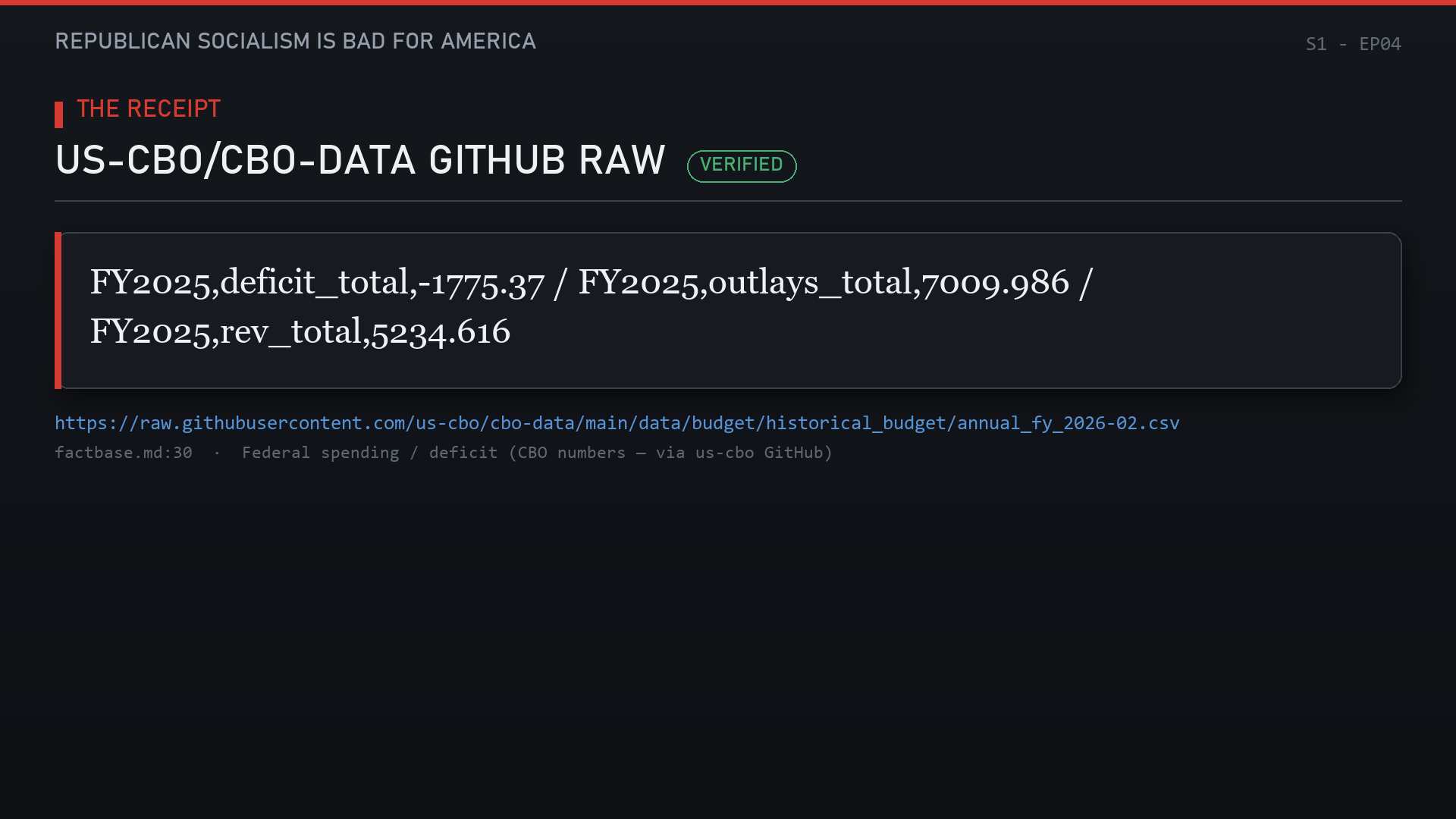
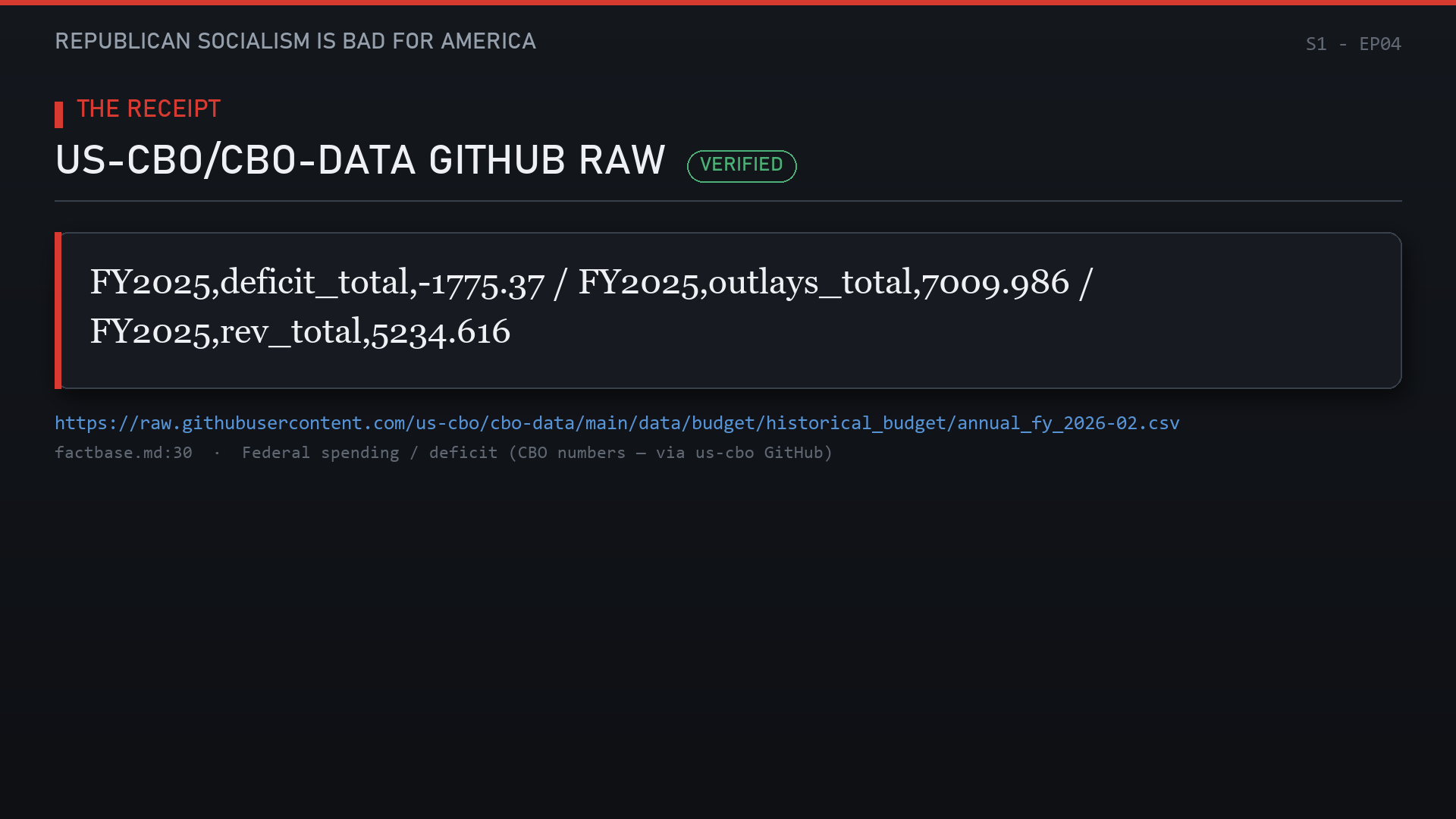
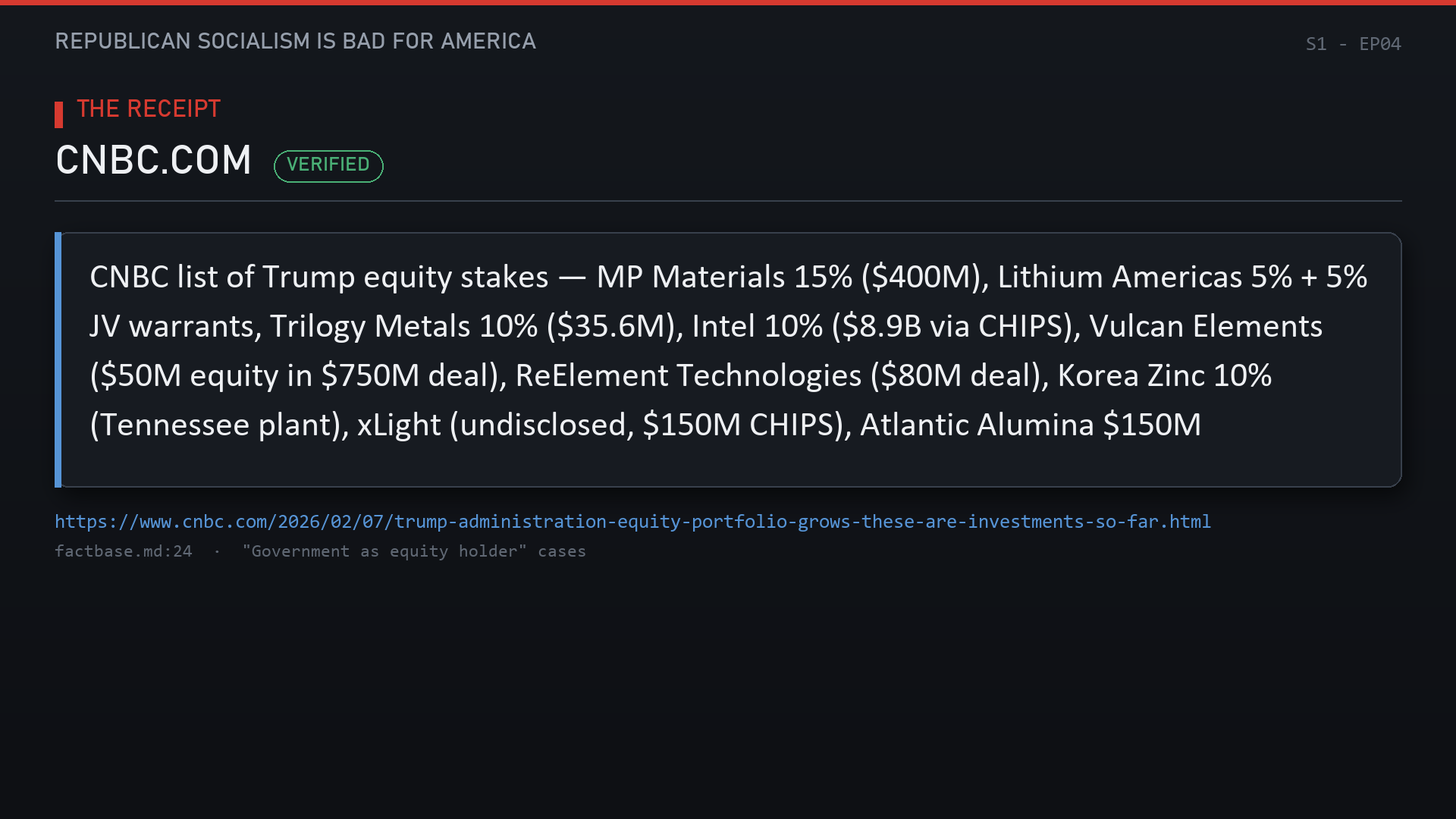
2025. The federal deficit swelled to $1.775 trillion — $7.010 trillion in outlays against $5.235 trillion in revenue, per CBO’s own numbers. By 2026 the shortfall climbs to $1.853 trillion and public debt hits 100.6% of GDP. Meanwhile the government quietly takes equity in critical-minerals firms — Trilogy Metals, Lithium Americas, MP Materials — DOGE’s savings claims don’t survive GAO review, and the promised $2,000 tariff dividend evaporated the moment the Supreme Court struck down the tariffs it depended on.
Deficits & Government Equity Every number below traces to a primary receipt. Click through.
Watch
Rough cut preview · real assets, sequenced by production order · not the final render.
Long-form · script and narration are recorded (see production materials); render has not shipped yet. Vertical and square cuts below play from the same file once it does.
Shorts & cuts
The Visual Basis (22 real production stills)
Every frame below is an actual rendered beat from this episode's build. These are the raw material the cut is built from, not stock or AI-generated art.
The Story
Fiscal year 2025 closes the books, and the books don’t close. Republicans hold the House, the Senate, and the White House. The deficit doesn’t check party registration.
CBO’s own historical ledger shows it: the federal government spent $7.010 trillion in FY2025 and collected $5.235 trillion in revenue — a $1.775 trillion hole. Next year’s forecast isn’t a correction, it’s a continuation: CBO’s ten-year projections put FY2026 outlays at $7.449 trillion against a deficit of $1.853 trillion — 5.8% of GDP — with debt held by the public climbing to 100.6% of GDP. The economy is about to owe more than it’s worth in a year.
The administration’s answer was supposed to be DOGE. Reuters tallied the unit’s own claimed contract savings in February 2025 at $8.5 billion — about one-eighth of one percent of what the government spends in a single year. Run the math forward and it would take more than 800 years of DOGE-pace cuts to offset one year of the FY2025 deficit.
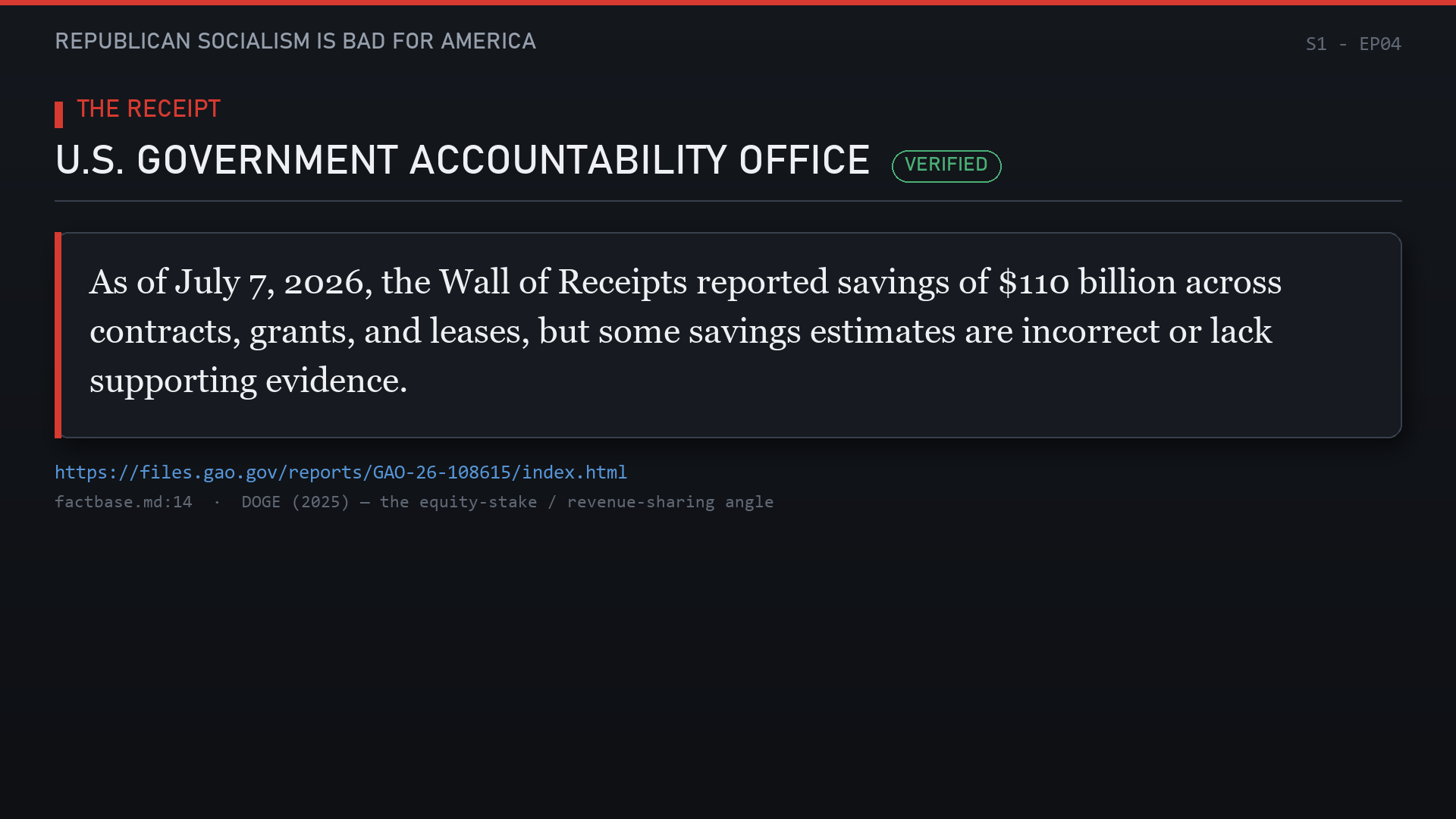
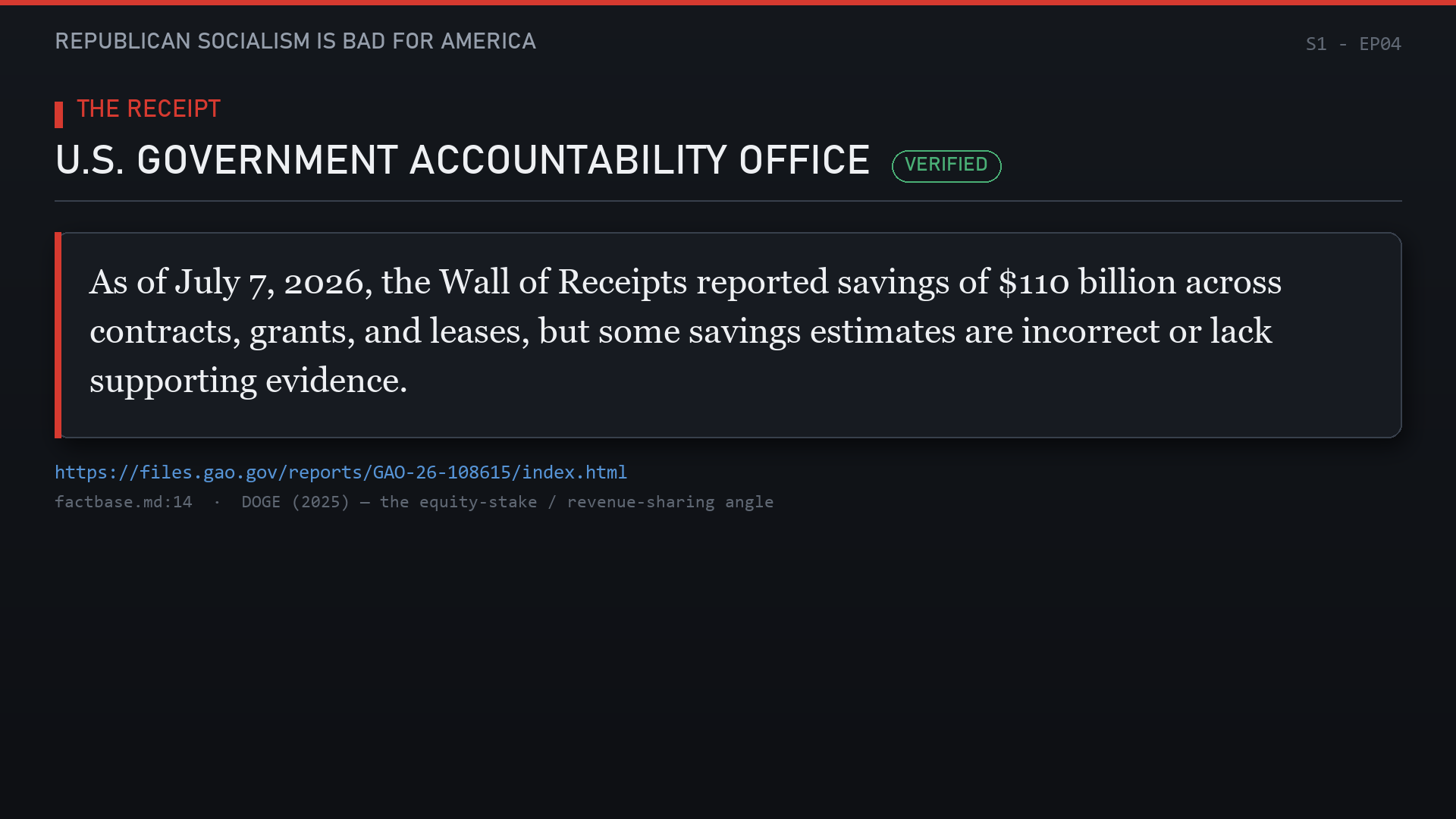
Even that number doesn’t survive contact with an audit. GAO went through DOGE’s self-published “Wall of Receipts” — $110 billion in claimed savings — and found $27.4 billion of it traces to 2,503 listed contracts on which no termination action was ever taken. GAO didn’t call the whole total fake. It called the receipts what they were: savings estimates that are “incorrect or lack supporting evidence.”
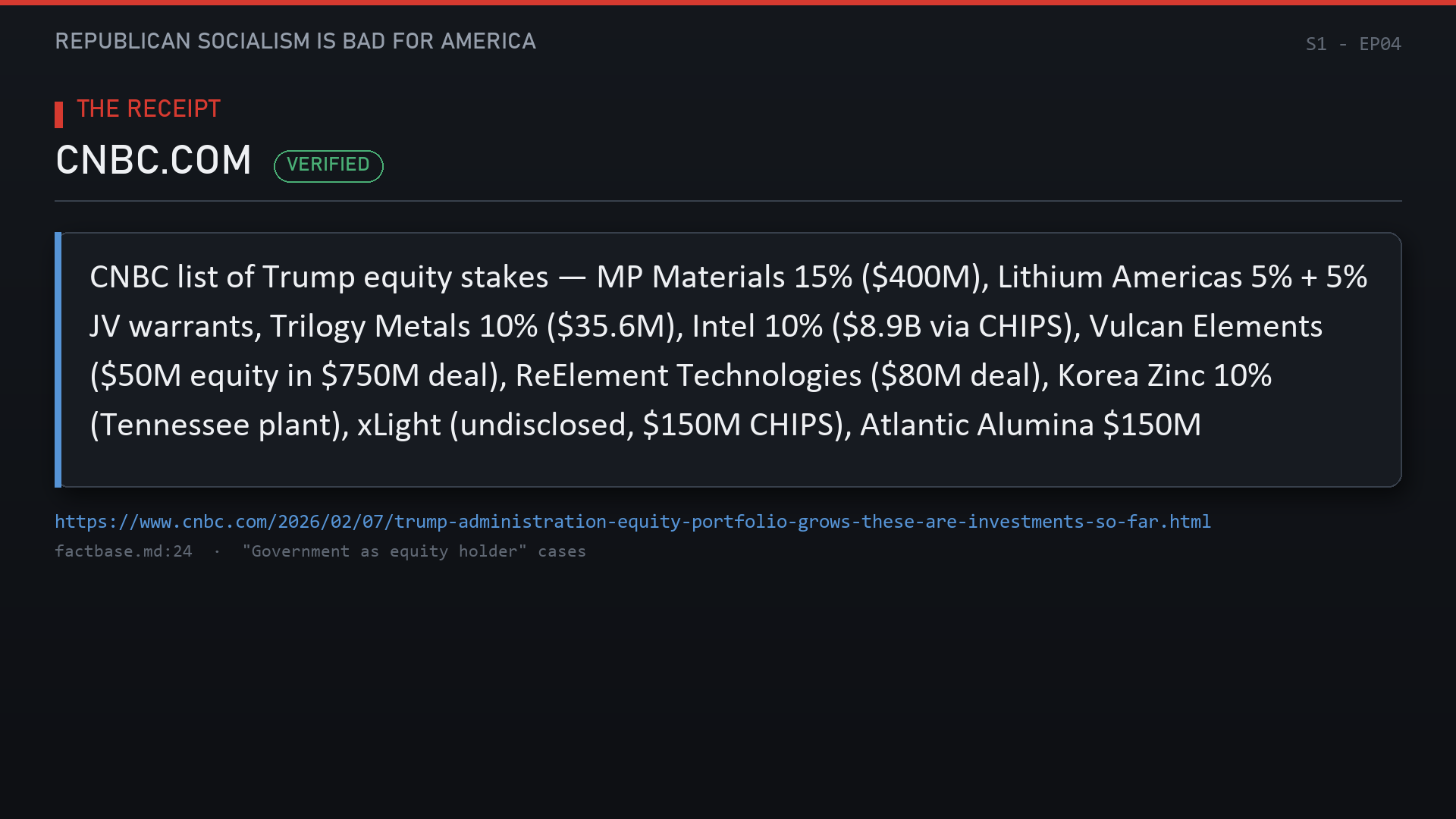
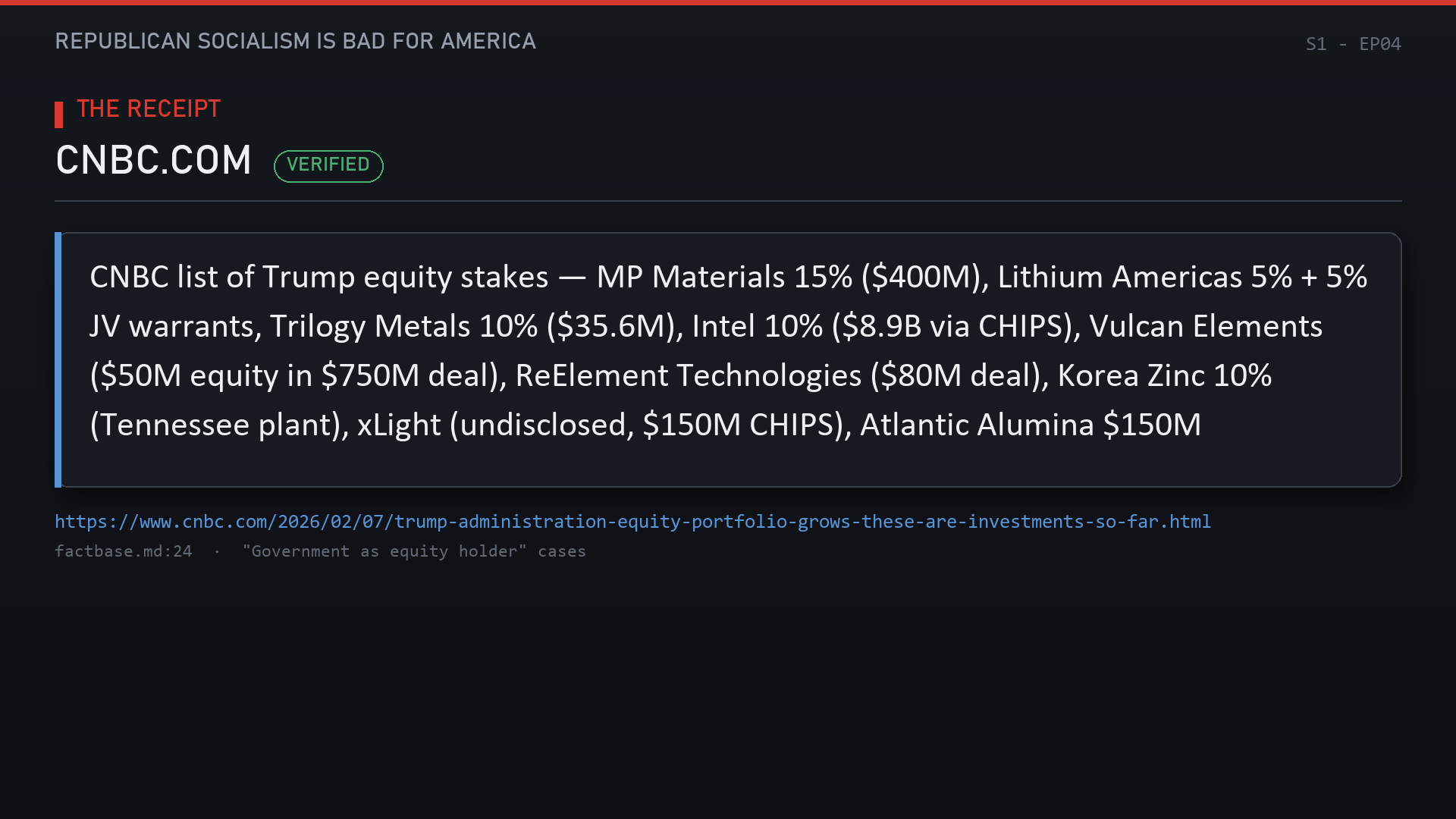
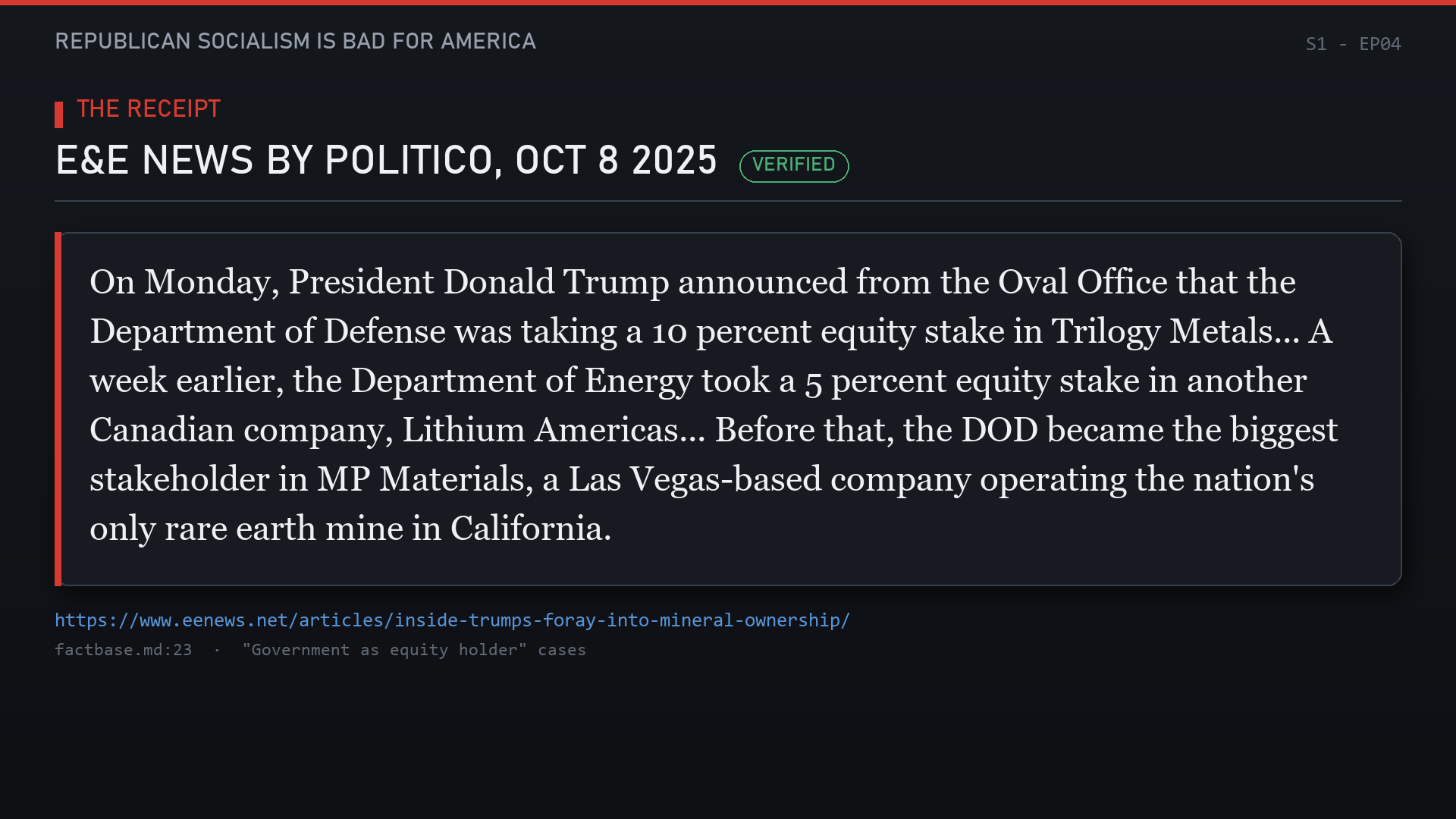
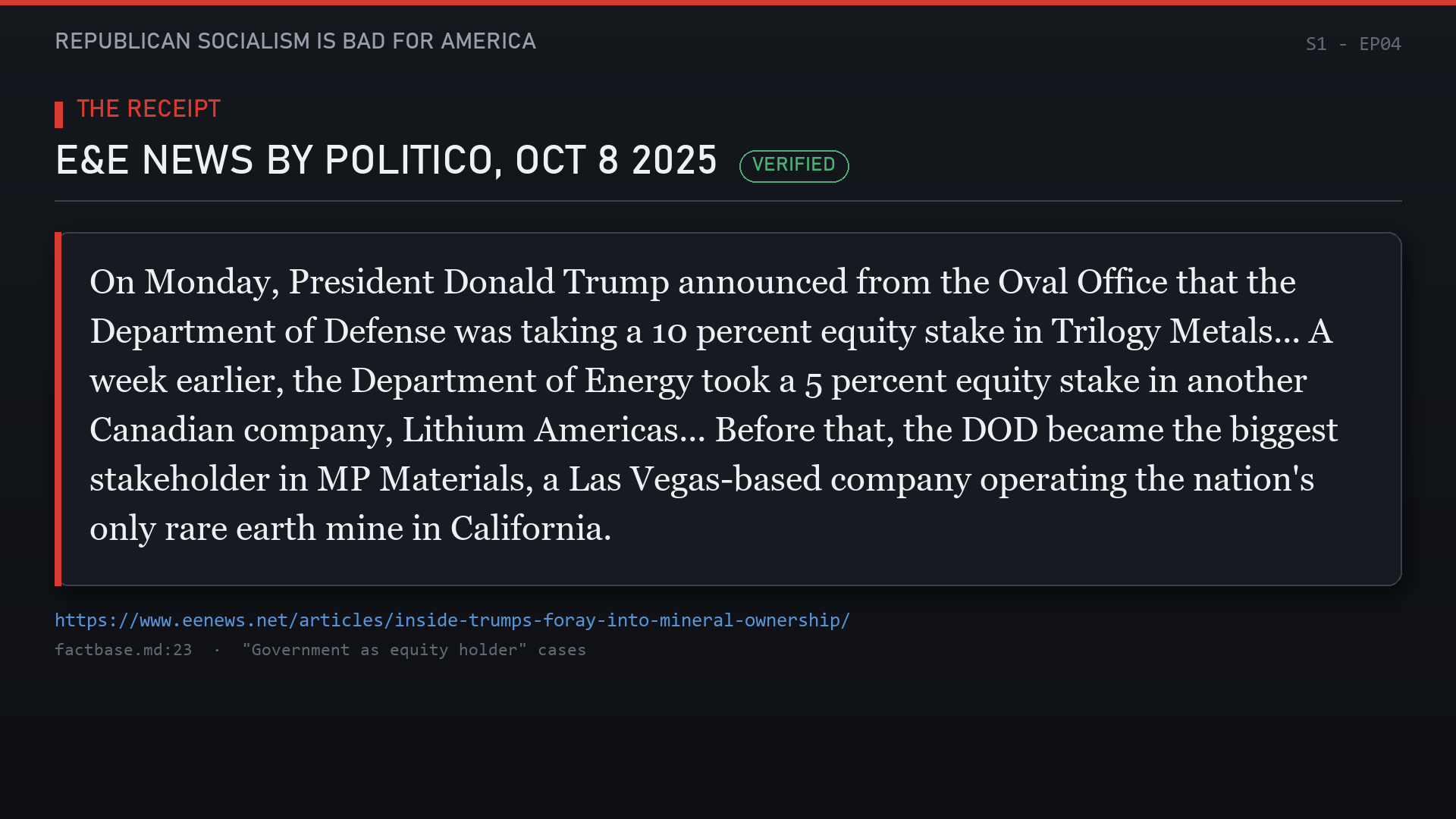
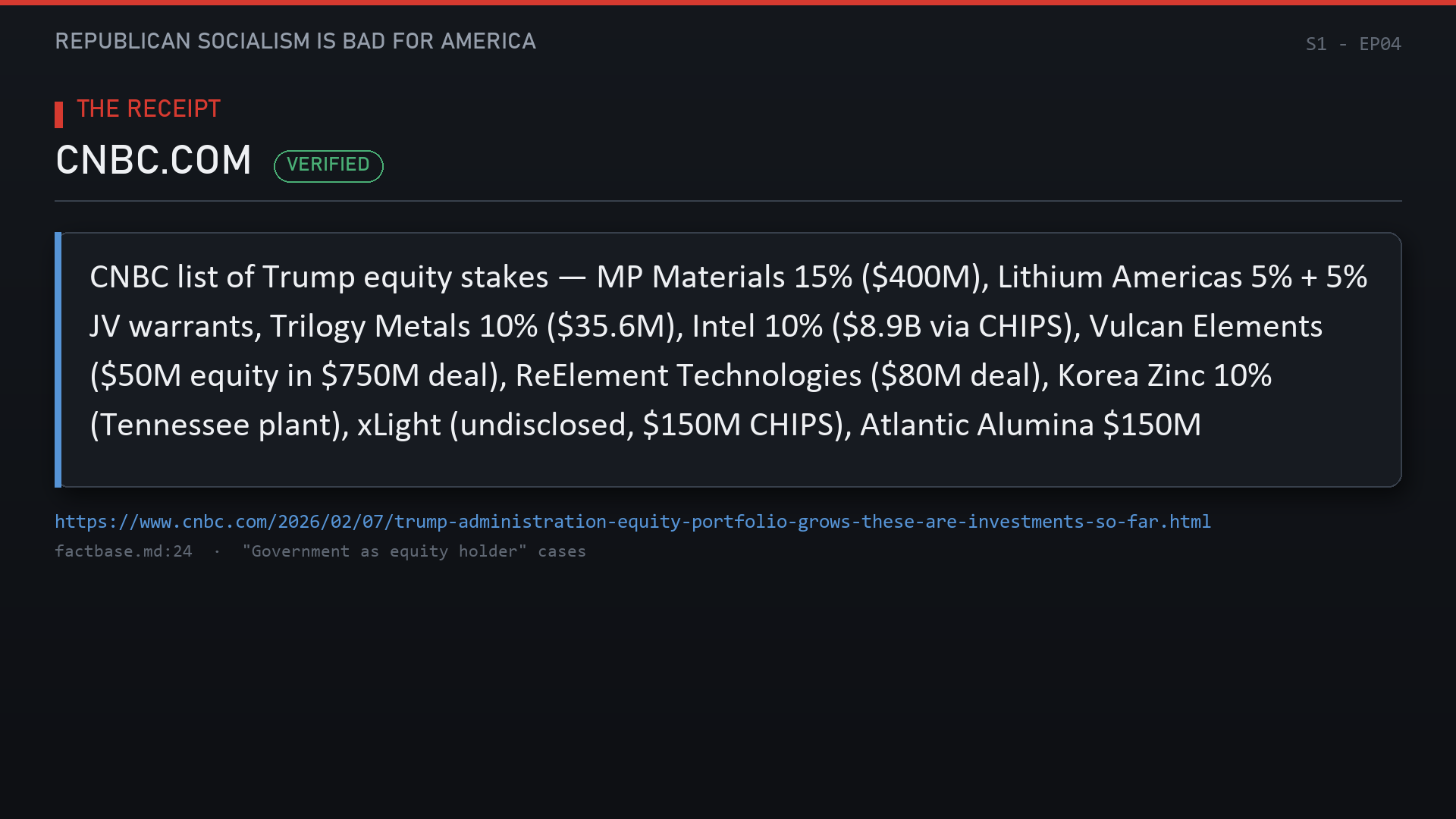
Meanwhile the government went shopping. This isn’t the TARP playbook — that 2008 program authorized $700 billion, actually disbursed $443.5 billion, and collected back $425.5 billion, landing at a lifetime cost of about $31.1 billion with a built-in exit. In October 2025 the Department of Defense took a 10% equity stake in Trilogy Metals, the Department of Energy took a 5% equity stake in Lithium Americas — a Canadian company — and the DOD had already become the largest stakeholder in MP Materials, the operator of the nation’s only rare earth mine. No wind-down date. No emergency to point to. Just ownership.
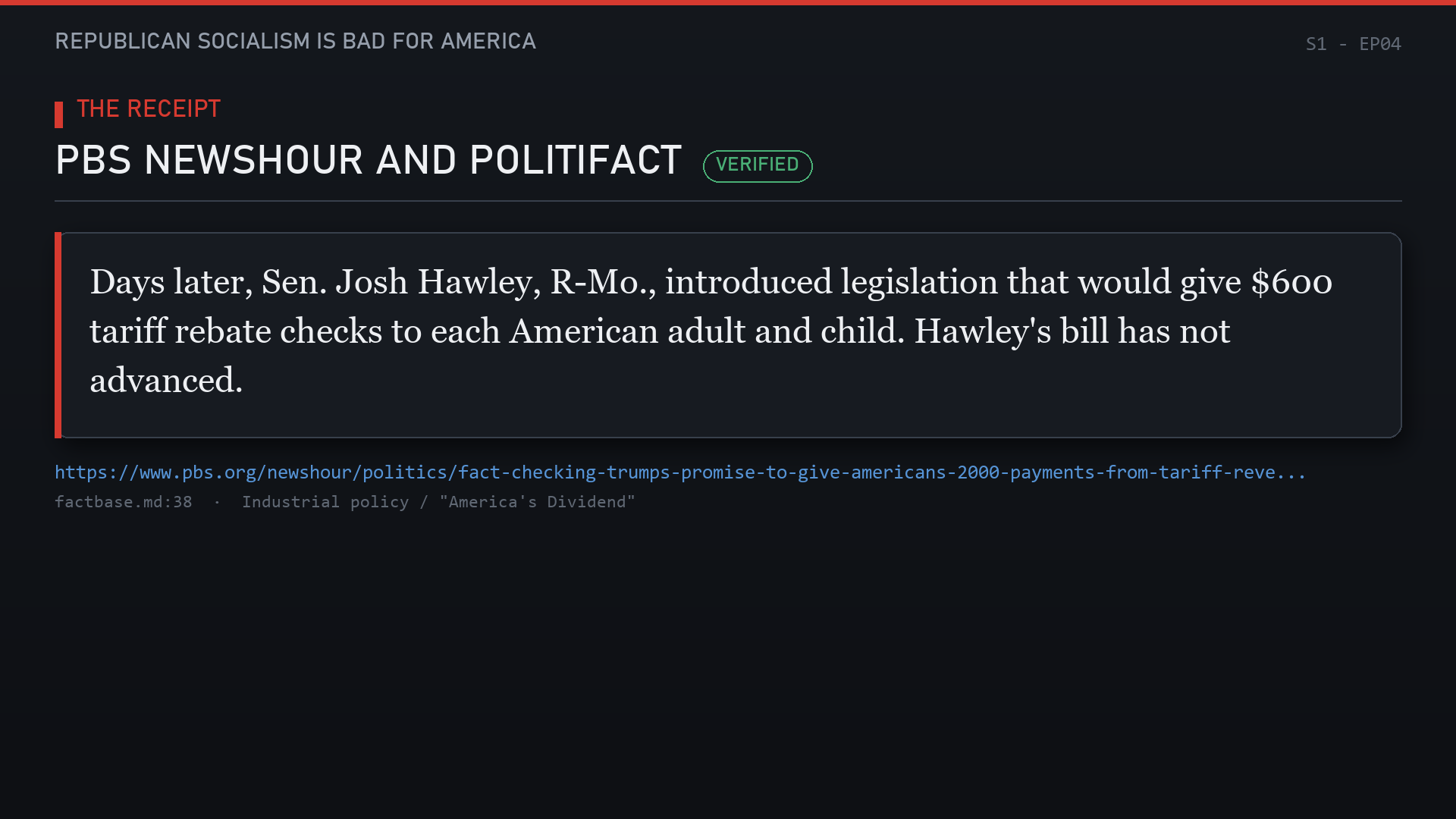
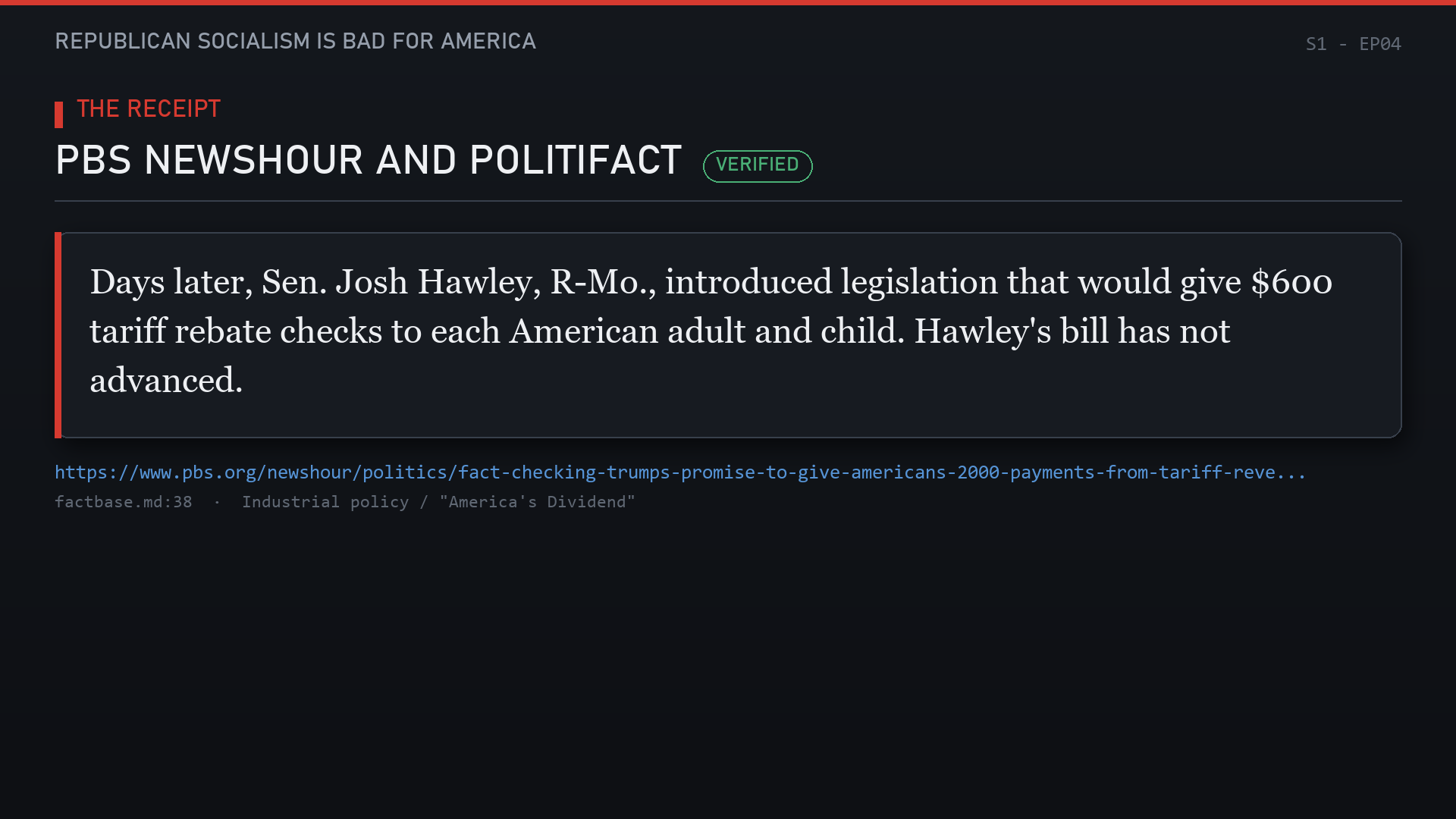
And here’s the reveal: the whole deficit story was supposed to have a release valve. On November 9, 2025, the president promised a dividend of at least $2,000 a person, funded by tariff revenue, paying down the $37 trillion national debt along the way. Sen. Josh Hawley filed a narrower version — $600, or a tariff-tied amount, whichever is greater — and it has sat in committee ever since, never advancing. Then, on February 20, 2026, the Supreme Court ruled the administration couldn’t impose those tariffs under IEEPA in the first place. CBO now estimates 2026 tariff and customs revenue will land $250 billion — 60% — below earlier projections, with roughly $100 billion already issued in refunds. The revenue that was supposed to fund the check the government already promised doesn’t exist anymore.
Zoom out and it’s the same shape every time: borrow against a number that isn’t there yet, spend before the audit lands, take an ownership stake nobody voted on, and bet the payoff on a court that hasn’t ruled. The deficit isn’t a talking point. It’s the one number in this episode that didn’t need a press release to be real.
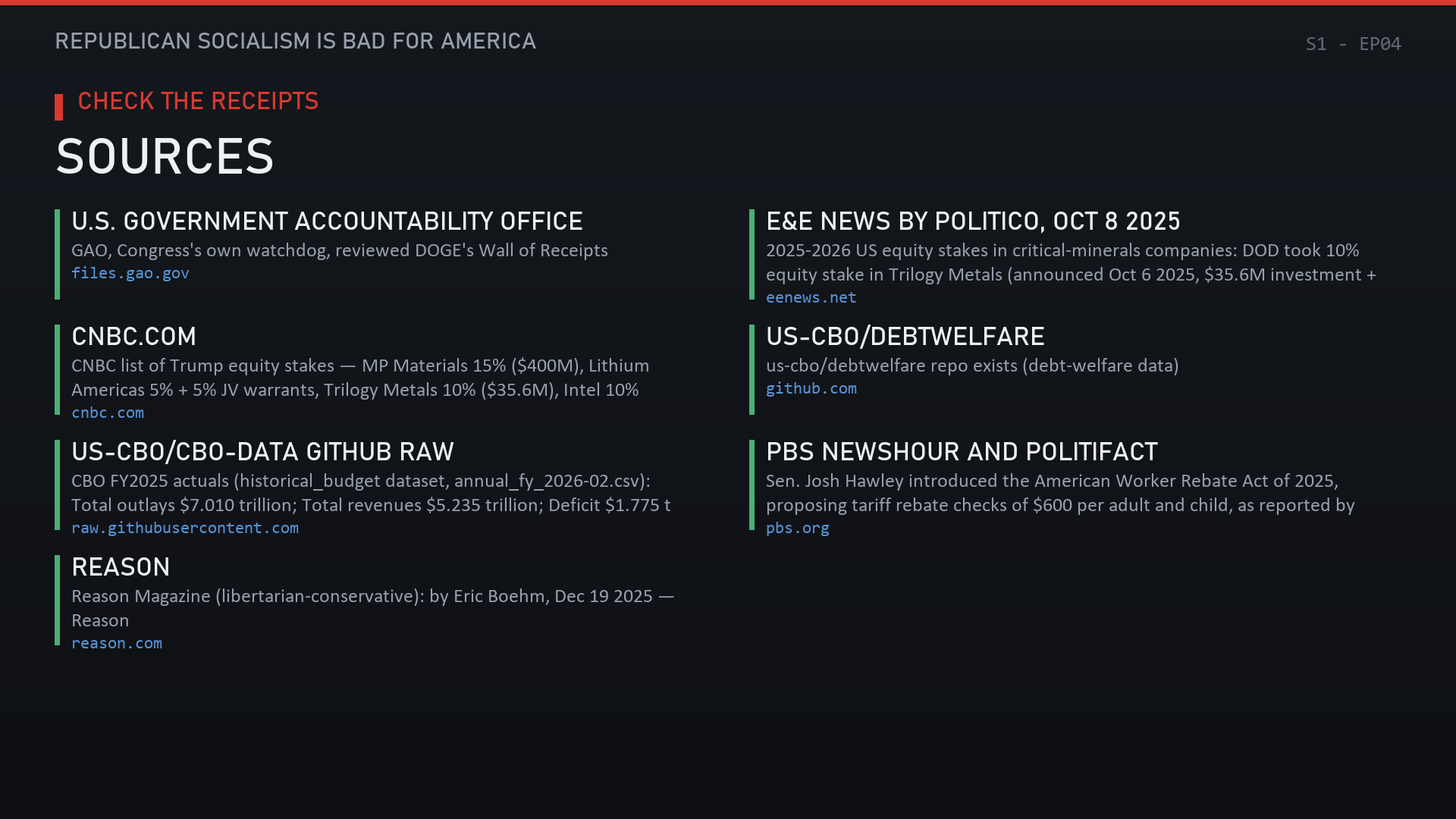
Receipts: CBO historical budget data · CBO ten-year budget projections · Reuters, Feb 19 2025 · U.S. GAO, GAO-26-108615 · U.S. Treasury, TARP program data · E&E News by POLITICO, Oct 8 2025 · PBS NewsHour / PolitiFact · S.2475, 119th Congress (GovTrack) · CBO, Monthly Budget Review, July 2026
The steelman
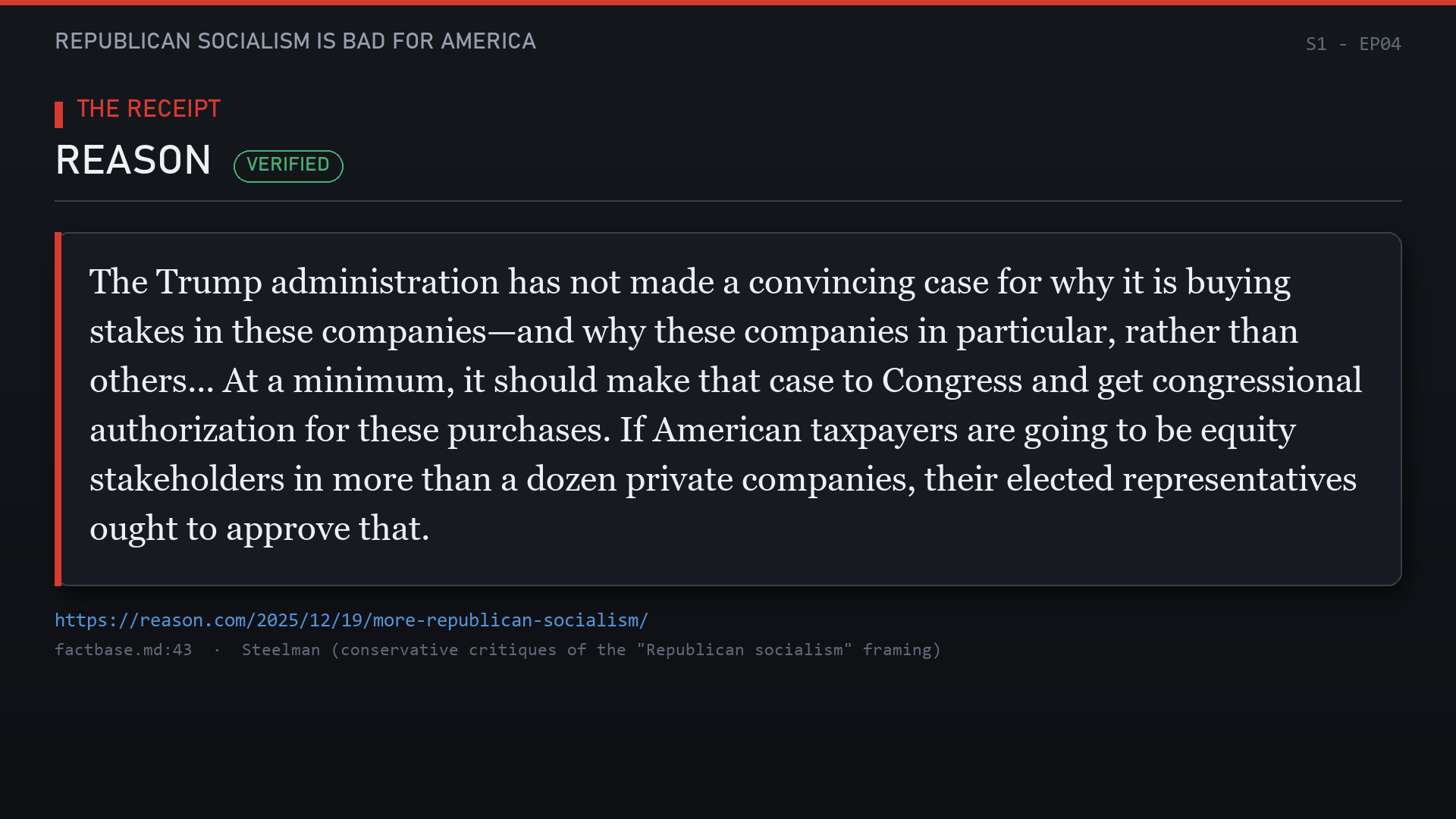
Conservative and libertarian critics make the strongest counter to the "Republican socialism" label. Reason's Eric Boehm: the administration "has not made a convincing case for why it is buying stakes in these companies—and why these companies in particular... If American taxpayers are going to be equity stakeholders in more than a dozen private companies, their elected representatives ought to approve that." National Review's John Puri warns federal equity stakes bring "untold economic distortions," comparing the pattern to "the same model that has faltered in China." Reason's Veronique de Rugy cites a Cato Institute count putting the federal corporate portfolio at roughly 30 firms, calling federal ownership of private companies "routine... on the right even as members busily point fingers at the left for its socialism." The Wall Street Journal's Greg Ip calls it "a two-way street" — businesses that align with the agenda get better treatment on China sales, tariffs, regulation, and mergers. And the New York Times' Bret Stephens: "If a Democratic president did this... Republicans would call it a political shakedown, an assault on capitalism, a loser for taxpayers. They'd be right."
The rebuttal
These critics are not defending the spending — they're arguing the label misses the more precise problem: state capitalism, regulatory capture, and the erosion of congressional authorization. That's a fair distinction, and we should report it honestly rather than insist on the word "socialism." But the distinction doesn't change the receipts: a Republican administration is taking equity stakes in private companies without clear authorization, its cost-cutting unit's savings claims don't hold up under inspection, its tariff revenue collapsed after a Supreme Court ruling, and CBO projects debt held by the public exceeding 100% of GDP. Whether you call that socialism, state capitalism, or industrial policy, the fiscal result is the same: more borrowing, more federal ownership, and less transparency.
The numbers are not on anyone's side. They just are.
Documents Used to Produce This Episode
No matching research-list documents found for this topic. The-53-list research folders were checked against EP04's actual subject — DOGE savings claims, critical-minerals equity stakes, CBO deficit/debt projections, and the tariff-dividend collapse — and none matched topically (the closest adjacent items, TARP and the GM/Chrysler auto bailout, cover a different historical episode and are cited directly in the master script itself, not linked here as a forced match).
Full production materials (internal — scripts, shot lists, handoff docs) →